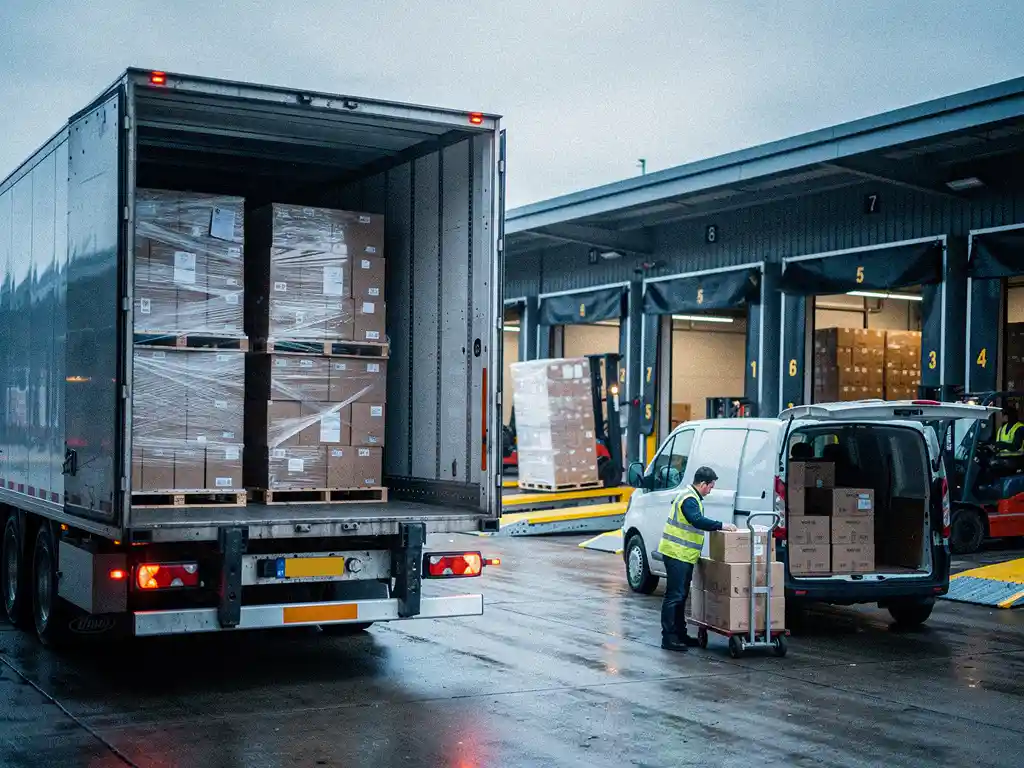
Running a mixed freight network means making dozens of decisions every day — and most of them come down to one question: do I fill a full truck or bundle this with something else? Getting the balance right between FTL (Full Truckload) and LTL (Less Than Truckload) is one of the most practical challenges transport planners face. Get it wrong, and you end up with half-empty trucks, missed delivery windows, or margins that quietly disappear. Get it right, and your network runs leaner, faster, and more profitably.
What is the difference between FTL and LTL freight?
FTL means a single shipper books the entire capacity of a truck for one shipment. The truck goes from A to B without stopping for other loads. LTL, or groupage, works differently: multiple shippers share space on the same truck, each paying for the portion of capacity they use.
FTL tends to be faster and more predictable. LTL, on the other hand, is more cost-efficient for smaller volumes — but it introduces more complexity. Transit times are longer, handling increases, and coordinating multiple pickups and drop-offs requires careful planning. Both models have their place, and understanding which is which is the starting point for smarter decisions.
What is a mixed freight network and how does it work?
A mixed freight network is one where FTL and LTL shipments coexist within the same planning environment. Rather than running a pure-play operation in one model, you are constantly evaluating each shipment and deciding how it fits into the broader picture.
In practice, this means some orders go out on dedicated trucks while others get consolidated into groupage loads. The challenge is that these decisions interact with each other. A groupage run that fills nicely today might create capacity problems tomorrow. A full truckload that looks efficient in isolation might have been better split and consolidated with other loads on the same corridor.
When should you choose FTL over LTL for a shipment?
There is no universal rule, but there are clear signals that point toward FTL. Volume is the most obvious one: when a shipment fills more than roughly 60 to 70 percent of a trailer, FTL usually becomes the more cost-effective choice. Time sensitivity is another factor. If a delivery window is tight and any delay at an intermediate stop creates risk, a direct FTL run removes that uncertainty.
Product characteristics also matter. Fragile, hazardous, or temperature-sensitive goods often require dedicated transport regardless of volume. And when the shipper-carrier relationship involves a contract rate that makes FTL competitive, there is little reason to introduce the complexity of consolidation.
How do you balance FTL and LTL to reduce empty kilometers?
Empty kilometers are the enemy of an efficient freight network. They represent cost without revenue, fuel burned without purpose, and capacity wasted. Balancing FTL and LTL well is one of the most effective levers for reducing them.
The key is treating consolidation as an active planning discipline rather than a fallback option. When a truck is heading in a direction with partial capacity, the question should always be: what else can go on this vehicle? That is where groupage planning earns its value. Systematically identifying shipments that can share a route and a vehicle — without compromising delivery commitments — turns wasted space into billable capacity.
This requires visibility across your full order book in real time, not just a snapshot from this morning. Conditions change throughout the day, and the best consolidation opportunities often emerge from new orders, cancellations, or last-minute changes that shift the picture entirely.
What are the biggest challenges of managing FTL and LTL together?
The complexity multiplies quickly when you are managing both models simultaneously. A few of the most common pressure points:
Timing mismatches between FTL departure windows and LTL consolidation cycles
Carrier constraints that apply differently to full loads versus groupage shipments
Data fragmentation across systems, making it hard to see the full picture at once
Manual decision-making that cannot keep pace with the volume of daily changes
For transport planners, this often translates into information overload. You are juggling orders across multiple systems, tracking carrier availability, monitoring live exceptions, and trying to make good decisions under time pressure. The risk of missing a consolidation opportunity or defaulting to a suboptimal FTL booking is very real.
How can AI help optimize FTL and LTL decisions in real time?
AI does not replace the planner’s judgment — it sharpens it. A well-designed AI assistant can process live order data, carrier constraints, and route parameters simultaneously, surfacing the best consolidation options before the window closes. It can flag when a groupage run is close to capacity and a new order fits perfectly, or when a planned FTL departure is worth waiting for because a matching load is about to come in.
The value is not in automating decisions away from planners. It is in reducing the cognitive load of tracking everything at once, so planners can focus on the calls that genuinely require human judgment. An AI that monitors your transport coordination in real time can catch the patterns and opportunities that are easy to miss when you are managing a busy day across multiple systems.
How LogicPlan helps with groupage planning
LogicPlan’s Groupage Planning Automation is built specifically for the challenge described throughout this article. It uses intelligent AI agents to analyze live order data, carrier constraints, and route parameters, automatically clustering shipments into optimized groupage loads. Instead of spending time manually bundling orders and second-guessing consolidation decisions, planners get a clear, up-to-date picture of the best groupage options available right now.
Here is what that looks like in practice:
Live order analysis that reflects actual conditions, not a morning snapshot
Automatic identification of consolidation opportunities across your full order book
Reduced empty kilometers through smarter load grouping on shared corridors
Works alongside your existing TMS via browser extension — no migration needed
Importantly, LogicPlan is not here to take over the planning. Our AI planning assistant learns alongside you, adapts to your individual planning patterns, and gets better over time. It supports your judgment rather than replacing it. If you want to see how it fits into your operation, get in touch with LogicPlan and we will show you what it looks like from day one.
Frequently Asked Questions
How do I know if my current FTL/LTL split is actually costing me money?
The clearest indicators are your average truck fill rate, empty kilometer percentage, and the frequency of late deliveries on LTL runs. If your trucks are regularly departing below 70% capacity on FTL routes, or if your LTL shipments are consistently missing delivery windows due to consolidation delays, you are likely leaving money on the table. Start by pulling a 30-day report on load utilization per route — patterns of waste tend to show up quickly once you look at the data in aggregate.
What is a realistic fill rate target for LTL consolidation runs?
Most efficient groupage operations aim for a fill rate between 80% and 90% of trailer capacity. Pushing beyond 90% can seem attractive but often introduces scheduling rigidity that leads to missed windows or forced last-minute FTL bookings, which erodes the cost savings. The sweet spot is consistent, predictable consolidation that keeps trucks full without creating downstream bottlenecks — and that balance looks slightly different depending on your corridors, carrier agreements, and delivery frequency.
Can FTL and LTL shipments be planned together in a single TMS, or do they need separate workflows?
They can and ideally should be planned together, but many legacy TMS platforms were built with one model in mind and struggle to give planners a unified view across both. The workaround most teams use — managing FTL in one system and LTL in spreadsheets or a separate tool — is exactly what creates the data fragmentation that leads to missed consolidation opportunities. If a full migration is not feasible, browser-based tools that sit on top of your existing TMS can bridge that gap without requiring a system overhaul.
What is the biggest mistake transport planners make when managing mixed freight networks?
Treating consolidation as a reactive fallback rather than a proactive planning discipline. In practice, this means LTL groupage only gets considered when a shipment is clearly too small to justify a full truck, rather than being evaluated as the first option across the full order book. The missed opportunity is significant: shipments that individually look like borderline FTL candidates can often be consolidated with other loads on the same corridor, reducing cost for everyone involved. Building consolidation logic into the front end of your planning process — not the back end — is where the gains are.
How far in advance should consolidation decisions be made to be effective?
Ideally, consolidation windows should be evaluated on a rolling basis throughout the day rather than locked in at a fixed planning cycle. The challenge with morning-only planning is that a significant portion of orders, cancellations, and capacity changes happen after that snapshot is taken. The most effective groupage operations use near-real-time order visibility so that new shipments can be slotted into existing loads before those loads depart — sometimes adding a perfectly matched order just hours before a truck leaves.
Does switching to more LTL consolidation affect carrier relationships or contract terms?
It can, and it is worth reviewing your carrier agreements before making a significant shift in volume allocation. Some contracts include minimum FTL volume commitments or rate structures that make FTL more attractive at certain thresholds. On the other hand, carriers running regular groupage corridors often offer competitive rates for consistent, well-organized consolidation volumes. The key is to approach the conversation with data — showing carriers a predictable, optimized load profile is a stronger negotiating position than ad hoc volume shifts.
How long does it typically take to see efficiency gains after improving FTL/LTL planning?
Most operations see measurable improvements in load utilization and empty kilometer rates within the first four to six weeks of applying a more structured consolidation approach. The initial gains tend to come from identifying obvious consolidation opportunities that were previously missed due to data fragmentation or manual planning limits. Deeper savings — from route-level optimization and carrier rate improvements — typically emerge over a three-to-six-month period as planning patterns stabilize and the system learns the specific characteristics of your network.
Next blog