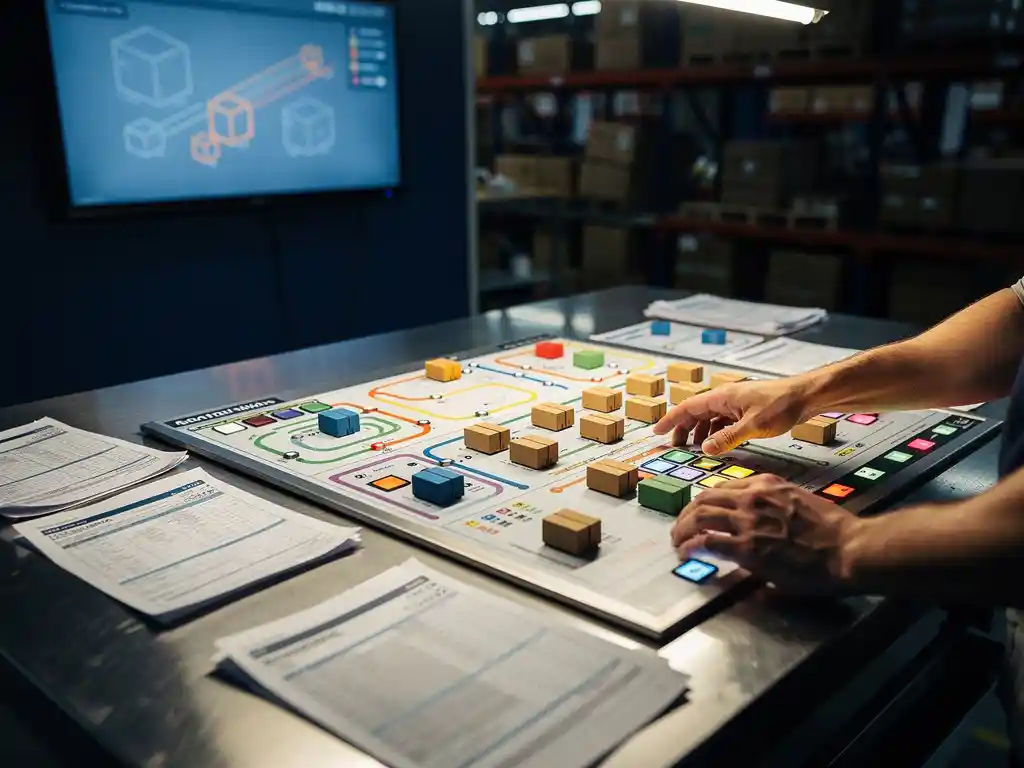
Groupage planning sits at the heart of efficient freight operations. Whether you are consolidating LTL (less-than-truckload) shipments into a shared load or deciding which orders can be bundled before committing to an FTL (full truckload) run, the quality of your planning depends entirely on the quality of your data. And in 2026, that data moves fast. Orders change, cancellations arrive mid-morning, and new pickups appear while you are still finalizing yesterday’s plan. Integrating live order data into groupage planning is no longer a nice-to-have. It is the difference between a plan that holds and one that falls apart before the first truck leaves the yard.
What is groupage planning and why does live data matter?
Groupage planning is the process of consolidating multiple smaller shipments from different customers or origins into a single transport unit. Instead of sending a half-empty truck for each order, you group compatible LTL freight together to fill capacity efficiently. Done well, it reduces cost per shipment, cuts empty kilometers, and makes better use of available carrier capacity. Done poorly, it creates delays, mismatched loads, and frustrated customers.
Live data matters because groupage decisions are time-sensitive. A plan built on order information from two hours ago may already be outdated. New orders arrive, existing ones are modified, and pickup windows shift. Without a continuous feed of current order data, planners end up making decisions based on a snapshot of reality that no longer exists.
What are the main sources of live order data in transport?
Live order data flows into planning environments from several directions simultaneously. Understanding where it comes from helps you design an integration that does not miss anything critical.
TMS (Transport Management System): The primary source for confirmed orders, delivery windows, and load specifications
Customer portals and EDI feeds: Direct order submissions and updates from shippers or freight forwarders
Email and messaging channels: Last-minute changes, cancellations, or special instructions that arrive outside structured systems
Carrier and driver apps: Real-time status updates on pickups, delays, and available capacity
The challenge is not a lack of data. It is that these sources do not always speak the same language or update at the same frequency. A live integration layer needs to normalize and reconcile these inputs before they reach your groupage logic.
How does live order data get connected to a groupage planning system?
Connecting live order data to a groupage planning system typically involves API integrations between your TMS, order management platform, and the planning engine itself. When an order is created or updated in the source system, a trigger sends that data to the planning layer, which re-evaluates current groupage assignments based on the new information.
Modern AI-powered planning assistants go further than simple data pipes. They actively monitor incoming data streams, interpret unstructured inputs like emails or portal messages, and translate them into structured planning actions. Rather than waiting for a planner to manually re-check the system, the integration works continuously in the background, flagging changes that affect current groupage plans and suggesting revised assignments.
What happens when a last-minute order change comes in during planning?
This is where traditional groupage planning breaks down. A cancellation arrives at 09:15 on a Monday morning. The affected load was already partially grouped with three other LTL shipments. Now the weight balance is off, the route no longer makes sense, and one carrier slot is underutilized. A planner working manually has to unpack the entire groupage, check carrier contracts, re-evaluate compatible orders, and rebuild the plan from scratch. That takes time that most operations simply do not have.
An AI-assisted approach handles this differently. When the cancellation comes in, the system identifies which groupage assignments are affected, checks available carrier options against contracted rates and historical performance, and generates a revised plan. The planner sees the proposed change, reviews it, and approves or adjusts it. What used to take hours can be resolved in minutes. And critically, the planner stays in control. The tool supports the decision, it does not replace the judgment behind it.
What’s the difference between batch planning and real-time groupage planning?
Batch planning means running your groupage optimization at fixed intervals, for example once in the morning and once in the afternoon. All orders received between runs are queued and processed together. This approach works in stable, predictable environments, but it creates a structural lag. By the time the batch runs, some of the inputs have already changed.
Real-time groupage planning processes order data continuously. As each new order, update, or cancellation arrives, the planning logic re-evaluates current assignments and adjusts where necessary. This does not mean the plan is constantly being rebuilt from scratch. It means the system is always working with current information, so the groupage decisions you make at any given moment reflect actual conditions rather than a historical snapshot. For FTL decisions especially, where the cost of a wrong call is high, this distinction matters enormously.
How do you avoid errors when integrating live data into groupage plans?
Live data integration introduces speed, but speed without validation creates a different kind of problem. Errors in source data, duplicate order entries, or conflicting updates can cascade through a groupage plan quickly if there is no check in place.
Validation rules: Define what a valid order update looks like before it touches the planning layer
Conflict detection: Flag situations where two data sources report different values for the same order
Human escalation paths: Ensure that exceptions requiring judgment are surfaced to a planner rather than resolved automatically
Audit trails: Log every change so planners can trace why a groupage decision was made and when
A real-time coordination assistant that monitors your live data streams can catch these issues before they affect the plan. The goal is not to remove human oversight but to make sure planners focus their attention where it actually matters, on the exceptions and edge cases that require experience and judgment, not on routine data reconciliation.
How LogicPlan helps with groupage planning
At LogicPlan, we built our Groupage Planning Automation specifically for the reality transport planners face every day: fragmented data sources, constant change, and not enough time to process it all manually. Our AI agents monitor live order data continuously, group LTL shipments into optimized load plans in real time, and adapt instantly when something changes. Here is what that looks like in practice:
Live data ingestion: We connect to your existing TMS and order channels without requiring a full migration
Autonomous groupage decisions: AI agents cluster shipments based on route parameters, carrier constraints, and real-time conditions
Planner-in-the-loop design: Every significant decision is surfaced to the planner for review. We learn alongside you, not instead of you
Fast deployment: Our browser extension works alongside your existing tools and is operational within minutes of installation
We are not here to replace transport planners. We are here to handle the data load so planners can focus on the decisions that actually require their expertise. LogicPlan grows with your team, learns your planning patterns over time, and gets better the more you use it. If you want to see how live order data integration can transform your groupage process, get in touch with LogicPlan and we will show you what it looks like in your operation.
Frequently Asked Questions
How long does it typically take to integrate live order data into an existing groupage planning setup?
The timeline depends on the complexity of your existing systems, but modern AI-assisted tools like LogicPlan are designed to minimize disruption. A browser extension-based approach can be operational within minutes, while a full API integration between your TMS and planning engine typically takes days to weeks rather than months. The key is choosing a solution that connects to your existing data sources without requiring a full system migration.
What if our TMS is outdated or doesn't support real-time API connections?
This is a common challenge, and it doesn't have to be a blocker. Many planning tools can ingest data through alternative channels such as EDI feeds, email parsing, or scheduled file exports, even when a live API isn't available. While you won't get true real-time updates from a legacy TMS, combining these fallback methods with live feeds from other sources (like carrier apps or customer portals) can still significantly improve the currency of your planning data compared to a purely manual process.
How do we handle situations where live data from different sources contradicts each other?
Conflicting data between sources, such as a TMS showing an order as confirmed while an EDI feed marks it as cancelled, is one of the most common pain points in live integration. The best practice is to define a clear source-of-truth hierarchy for each data type during your integration setup, so the system knows which source to prioritize when conflicts arise. Any unresolvable conflict should be automatically escalated to a planner rather than silently resolved, which is why human escalation paths and audit trails are non-negotiable components of a reliable live data setup.
Can real-time groupage planning work for operations that run fixed daily schedules?
Absolutely, and it often delivers the most value in exactly these environments. Even when your departure times are fixed, the groupage decisions leading up to those cutoffs benefit enormously from working with the most current order data available. Real-time planning doesn't mean constant replanning — it means that when you do finalize a groupage at your scheduled cutoff, the plan reflects actual conditions rather than data that's several hours old. The result is fewer last-minute surprises and better-utilized loads.
What are the most common mistakes teams make when first implementing live order data integration?
The most frequent mistake is going live without proper validation rules, allowing raw, unfiltered data to flow directly into the planning layer and cause cascading errors. A close second is underestimating the volume of unstructured inputs, like emails and portal messages, that carry critical order changes but fall outside the structured data pipeline. Start by mapping all your order data sources, define validation logic before go-live, and ensure your integration handles both structured and unstructured inputs from day one.
How does an AI planning assistant 'learn' our groupage patterns over time, and what does that mean practically?
AI planning tools learn by observing the decisions planners make and the outcomes those decisions produce, such as which groupage clusters consistently perform well on cost and delivery time, or which carrier pairings a planner tends to prefer for certain route types. Over time, this means the system's suggested groupage assignments become increasingly aligned with your team's actual planning logic, reducing the number of manual adjustments needed. In practice, planners typically find that the tool requires less correction the longer it's been in use.
Is real-time groupage planning only relevant for large freight operations, or can smaller carriers benefit too?
Smaller operations often benefit just as much, if not more, because they have less buffer to absorb the cost of a poorly optimized load or a missed groupage window. The key difference is scale: a smaller carrier may not need enterprise-grade infrastructure, but the core problem — making good consolidation decisions with fast-moving order data — is identical. Lightweight tools that work alongside existing systems without requiring a full TMS overhaul are particularly well-suited to smaller teams who need better planning capability without a large implementation investment.
Next blog