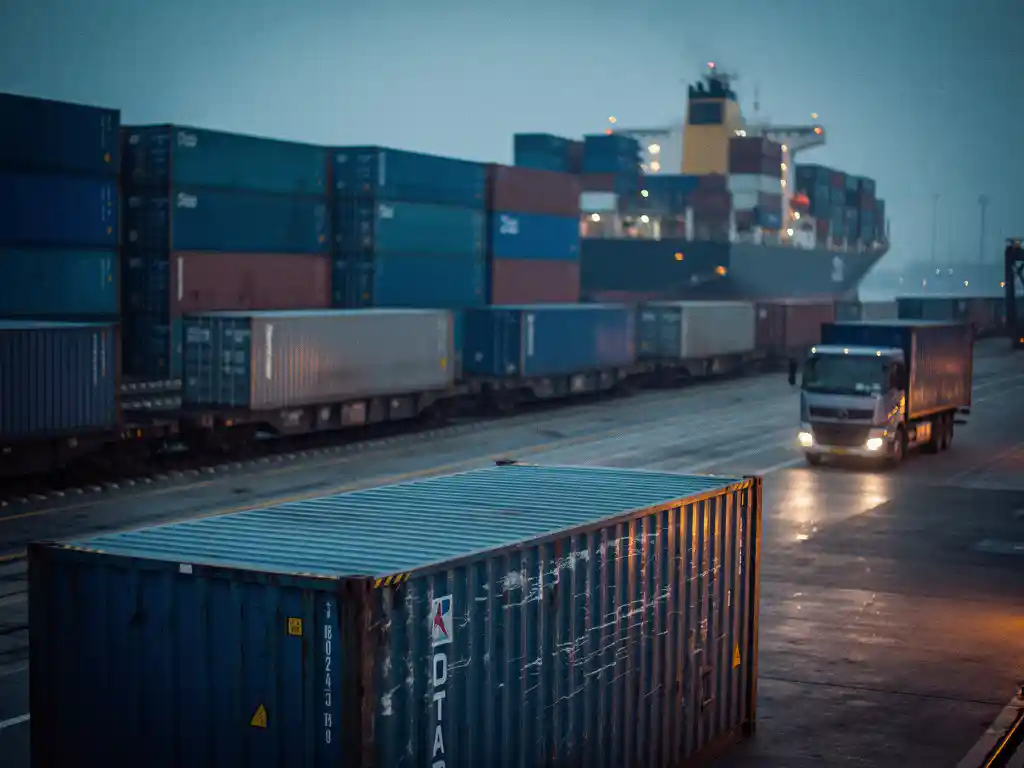
Multimodal transport is one of the most complex challenges a transport planner faces every day. You’re not just moving freight from A to B — you’re coordinating trucks, trains, barges, and sometimes air freight, all within tight windows and shifting conditions. When something changes mid-route, the ripple effects spread fast. Traditional planning tools were never built for this kind of complexity, which is why AI freight planning is gaining serious traction among logistics operations in 2026.
What is multimodal transport and why does it matter for freight planning?
Multimodal transport means moving a single shipment across more than one mode of transport — for example, a container that travels by truck to a rail terminal, continues by train to a port, and then transfers to a barge for final delivery. The freight itself stays in the same loading unit throughout, but the coordination behind it involves multiple carriers, handover points, schedules, and contracts.
For freight planning, this matters enormously. Each mode has its own lead times, capacity constraints, and booking requirements. A delay at one handover point cascades into every leg that follows. Planners managing multimodal flows need to hold an enormous amount of interconnected information in mind simultaneously — and act quickly when something goes wrong.
What challenges does multimodal freight planning create for transport planners?
The core difficulty is not just complexity — it is the speed at which that complexity changes. Conditions shift constantly: a train cancellation, a barge running behind schedule, a driver running out of hours before reaching the terminal. Each event forces a replanning decision that affects multiple shipments, multiple carriers, and multiple time windows at once.
Transport planners dealing with multimodal freight typically face these recurring pain points:
Information scattered across emails, portals, TMS systems, and carrier messages
No single view of where all shipments stand across all modes at any given moment
Manual recalculation of alternatives when a leg fails or a connection is missed
Difficulty comparing carrier options against contract rates and historical reliability under time pressure
The result is that planners spend a disproportionate amount of their day reacting rather than planning — firefighting instead of optimizing.
How does AI freight planning work across multiple transport modes?
An AI freight planning tool built for multimodal operations works by continuously ingesting live data from all relevant sources — carrier APIs, track-and-trace systems, order management platforms, and communication channels — and reasoning across that data in real time. Rather than waiting for a planner to notice a problem and manually work through the options, the AI agent detects the disruption, identifies which shipments are affected, evaluates available alternatives across modes, and surfaces a revised plan.
This is fundamentally different from running a static optimization at the start of the day. The planning loop stays open and active throughout the day, adapting as conditions evolve. When a cancellation arrives by email or portal message, the system does not just flag it — it works through the implications and presents actionable options, so the planner can make a fast, informed decision rather than starting from scratch.
Crucially, this is not about replacing the planner’s judgment. The AI works alongside the planner, learning individual planning patterns and preferences over time. It handles the information processing and option generation; the planner retains control over the final call. The system gets smarter the more it works with you — remembering exceptions, recognizing patterns, and adapting to the way you actually think.
What’s the difference between AI freight planning and traditional transport software?
Traditional transport software — including most TMS platforms — is built around structured rules and static optimization logic. It performs well when the inputs are clean and the conditions are stable. But real logistics operations are neither of those things. Rules break down at the edges, and static solvers produce plans that are already outdated by the time they are generated.
AI shipment scheduling through an agent-based approach handles the messy, unstructured reality of live operations. It can read an unstructured email, extract the relevant information, cross-reference it against current plans, and trigger a replanning sequence — all without manual data entry. This closes the gap that rule-based systems have never been able to bridge: the gap between optimized logic and operational reality.
Another practical difference is deployment. A well-designed AI planning assistant does not require replacing your existing TMS or migrating your data. It works alongside the tools you already use, accessible through a browser extension, and can be operational within minutes of installation. There is no lengthy implementation project standing between you and the benefit.
How can AI reduce empty kilometers and costs in multimodal freight?
Empty kilometers are one of the most visible cost drivers in freight operations, and they are especially common in multimodal flows where repositioning vehicles between handover points is unavoidable — unless the planning is genuinely optimized. Freight planning automation addresses this by grouping shipments intelligently, consolidating loads that share route segments across modes, and identifying consolidation opportunities that a planner working manually under time pressure would simply miss.
By analyzing live order data, carrier constraints, and route parameters simultaneously, an AI system can cluster shipments into efficient groups in real time — adjusting those groups as new orders arrive or conditions change. This is not a one-time optimization run; it is a continuous process that reflects actual operational conditions rather than a snapshot taken at the start of the day.
When should a logistics operation consider AI freight planning?
The honest answer is: when the manual coordination burden is consistently eating into time that should be spent on higher-value decisions. If your planners are spending Monday mornings untangling weekend disruptions, if carrier exceptions are landing by email and taking hours to resolve, or if your multimodal flows involve enough moving parts that a single disruption regularly cascades into a half-day of replanning — these are clear signals that the current approach is not scaling with the complexity of your operation.
A real-time coordination assistant becomes especially valuable when the volume and variety of incoming information exceeds what any individual planner can monitor reliably. It is not about whether your team is capable — it is about giving capable planners the right support so their expertise goes toward decisions, not data processing.
How LogicPlan helps with groupage planning
Our Groupage Planning Automation is designed specifically to solve the consolidation challenge at the heart of multimodal freight. Instead of relying on static rules or manual bundling, we use intelligent AI agents to continuously analyze live order data and group shipments into optimized load plans that reflect real conditions — not yesterday’s assumptions.
Here is what that looks like in practice:
Live order data, carrier constraints, and route parameters are analyzed simultaneously and continuously
Shipments are clustered into efficient groups in real time, adapting as new orders arrive or conditions change
Empty kilometers are reduced by identifying consolidation opportunities across modes that manual planning would miss
Planning time drops from hours to minutes, freeing planners to focus on decisions that require human judgment
LogicPlan does not replace your planners — it works with them. Our system learns your planning patterns, remembers exceptions, and improves over time so that every groupage decision gets sharper the longer we work together. If you want to see what this looks like for your operation, get in touch with us and we will walk you through it.
Frequently Asked Questions
How long does it typically take to get an AI freight planning tool up and running?
A well-designed AI planning assistant can be operational within minutes — not weeks or months. Because it works alongside your existing TMS and tools rather than replacing them, there is no lengthy data migration or implementation project required. You install it as a browser extension, connect it to your existing data sources, and it begins learning your planning patterns from day one.
What happens if the AI suggests a replanned route that I disagree with as a planner?
The AI surfaces options and recommendations — the final decision always stays with you. If you override a suggestion, a well-designed system will register that exception and factor it into future recommendations, gradually learning your preferences and the specific constraints of your operation. Think of it less as an autopilot and more as a highly informed colleague who does the groundwork so you can make a faster, better-informed call.
Can AI freight planning handle shipments that involve irregular or less common transport modes, like inland waterways or short-sea shipping?
Yes — as long as the relevant carrier APIs, track-and-trace feeds, or data sources can be connected, the AI can reason across them the same way it does for road and rail. Inland waterways and short-sea shipping come with their own scheduling patterns and constraints, and an agent-based system is designed to work with that variability rather than around it. The key is that the system ingests live operational data rather than relying on static timetables.
What are the most common mistakes logistics operations make when first adopting AI freight planning?
The most frequent mistake is treating AI as a one-time optimization tool rather than a continuous planning layer — running it once at the start of the day and then reverting to manual processes when disruptions hit. Another common pitfall is underinvesting in data connectivity: the AI is only as good as the live data it can access, so fragmented or delayed data feeds will limit its effectiveness. Starting with a focused use case, like groupage planning or disruption replanning, and expanding from there tends to deliver faster, more measurable results than trying to automate everything at once.
How does AI freight planning handle situations where carrier data or track-and-trace information is incomplete or delayed?
A robust AI planning system will flag data gaps and work with the most recent reliable information available, rather than silently producing plans based on stale inputs. In practice, it can also process unstructured inputs — like a carrier email or portal message — to fill gaps that structured data feeds miss. Over time, the system builds a reliability profile for each carrier and route, which helps it weight alternatives more accurately even when real-time data is imperfect.
Is AI freight planning only viable for large logistics operations, or can smaller transport companies benefit too?
The complexity threshold matters more than company size. A mid-sized operation running multimodal flows with multiple carriers, tight handover windows, and frequent disruptions will benefit just as much as a large enterprise — sometimes more, because smaller planning teams have less capacity to absorb the manual coordination burden. If your planners are consistently spending significant time on information gathering and replanning rather than decision-making, the operational case for AI assistance is there regardless of your overall shipment volume.
How do I measure whether AI freight planning is actually delivering ROI for my operation?
The most direct metrics to track are planning time per shipment, empty kilometer percentage, the number of disruptions that required manual escalation versus those resolved automatically, and on-time delivery rates across multimodal legs. Baseline these figures before implementation and review them at 30, 60, and 90 days. Softer but equally important signals include planner satisfaction and the proportion of their day spent on reactive firefighting versus proactive decision-making — a shift here is often the earliest visible sign that the system is working.
Next blog