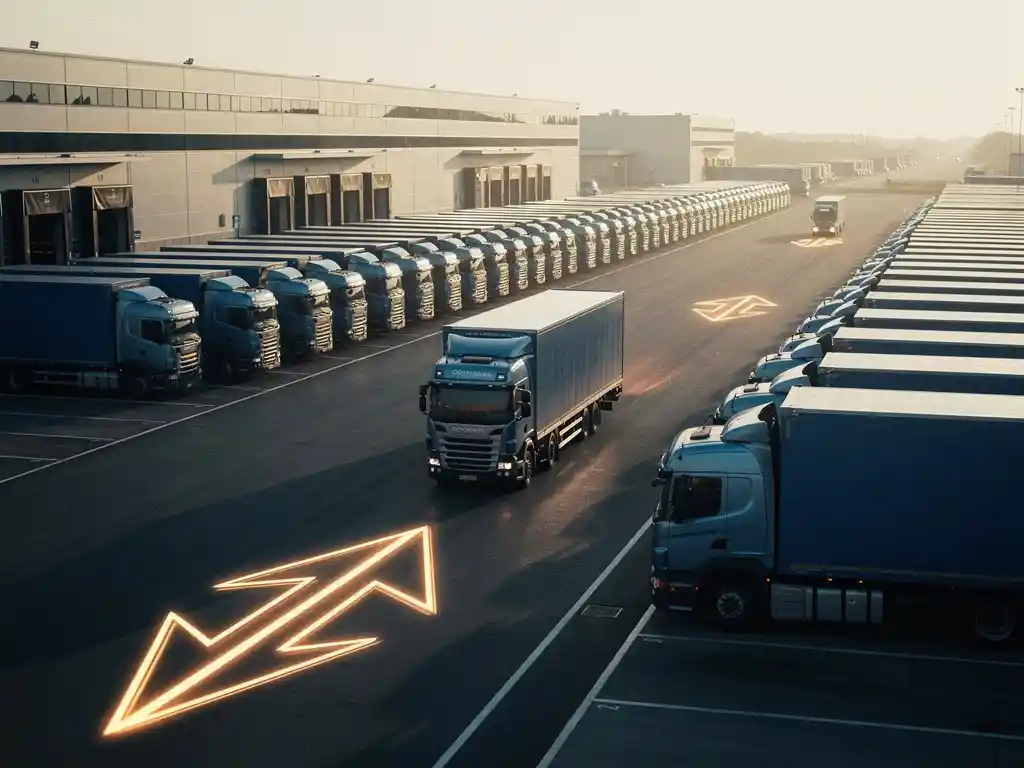
Transport planning has always been a fast-moving, high-pressure job. Orders change, drivers call in sick, and no two Mondays look the same. For years, planners have relied on a combination of experience, instinct, and software that was never quite fast enough to keep up. That is changing. In 2026, AI shipment scheduling is giving transport planners a smarter, more responsive way to manage the chaos, without replacing the human judgment that makes great planning possible.
What is AI shipment scheduling?
AI shipment scheduling is the process of using artificial intelligence to automatically plan, assign, and adjust freight movements in real time. Rather than relying on fixed rules or manual input, an AI freight planning tool analyzes live data, such as order volumes, carrier availability, route conditions, and delivery windows, and translates that into actionable plans within seconds.
The key distinction is adaptability. Traditional scheduling systems produce a plan and stick to it. AI shipment scheduling continuously re-evaluates that plan as new information comes in, making it far better suited to the unpredictable nature of real logistics operations.
How does AI shipment scheduling actually work?
At its core, AI shipment scheduling works through a network of intelligent agents that each handle a specific part of the planning process. One agent monitors incoming orders, another checks carrier contracts and availability, another validates route feasibility, and an orchestrating agent ties all of this together into a coherent plan.
When a cancellation arrives, whether by email, portal message, or another channel, the system detects it immediately. It identifies which loads are affected, checks which carrier options are available against current contract rates and performance history, and generates a revised assignment plan, often in minutes rather than hours. This is what separates genuine freight planning automation from simple rule-based tools that can only respond to situations they were explicitly programmed for.
What’s the difference between AI scheduling and traditional transport planning software?
Traditional transport planning software is built around structured logic. It works well when conditions are predictable and data is clean. The problem is that real logistics rarely stays clean or predictable for long.
Static solvers produce a plan based on the data available at that moment. By the time the plan is ready, circumstances may have already shifted. AI freight planning, by contrast, operates continuously. It ingests live data, splits complex problems into manageable tasks, calls the right solvers and APIs, validates outputs, and escalates exceptions that genuinely require a human decision. The result is a planning process that stays current, rather than one that is always playing catch-up.
What types of disruptions can AI shipment scheduling handle?
One of the strongest arguments for adopting an AI freight planning tool is its ability to handle disruptions that would otherwise consume hours of a planner’s day. These include:
Last-minute order cancellations or additions that require load rebalancing
Driver unavailability requiring rapid reassignment across carriers
Traffic or weather events that make planned routes unviable
Carrier capacity shortfalls during peak demand periods
In each case, the AI does not just flag the problem. It works through the options, applies the relevant constraints, and presents a revised plan. The planner stays in control of the final call, but the heavy lifting has already been done.
How does AI shipment scheduling reduce empty kilometres and fuel costs?
Empty kilometres are one of the most persistent and costly inefficiencies in road freight. They happen when loads are not grouped efficiently, when return journeys are not planned, or when last-minute changes leave vehicles running without cargo.
AI shipment scheduling reduces empty kilometres by continuously optimizing how orders are clustered and routed. By analyzing real-time order data alongside carrier constraints and route parameters, the system finds consolidation opportunities that a planner working manually, across multiple systems and under time pressure, would easily miss. Smarter grouping means fewer unnecessary trips, which directly reduces fuel consumption and operational costs over time.
When should a transport company switch to AI shipment scheduling?
The honest answer is that the right moment is when manual planning is consistently slowing you down or producing outcomes that feel like they could be better. Common signals include planners spending the first hours of every morning firefighting, recurring issues with empty return legs, or a growing volume of orders that the current process simply cannot handle at speed.
It is also worth noting that switching does not have to mean starting from scratch. The right AI freight planning tool works alongside your existing systems, learning from the way your team already plans, rather than demanding a full process overhaul before you see any benefit.
How LogicPlan helps with groupage planning
LogicPlan’s Groupage Planning Automation is built specifically to solve the bundling problem that costs transport companies time, money, and kilometres every single day. Instead of relying on static rules or manual consolidation, our AI agents analyze live order data, carrier constraints, and route parameters to cluster shipments into efficient groups in real time.
Here is what that means in practice:
Planning time drops from hours to minutes, even on the busiest mornings
Empty kilometres fall as consolidation opportunities are identified automatically
Every groupage decision reflects current conditions, not yesterday’s data
Importantly, LogicPlan is not here to replace your planners. Our system is designed to work with the people who know your operation best. It learns individual planning patterns, remembers exceptions, and improves over time, so the longer your team uses it, the smarter it gets. It installs as a browser extension, works alongside your existing TMS without any migration, and is operational within minutes. If you are ready to see what smarter groupage planning looks like for your operation, get in touch with LogicPlan and we will show you.
Frequently Asked Questions
How long does it typically take to see measurable results after implementing AI shipment scheduling?
Most transport companies begin to see operational improvements within the first few weeks of use, particularly in planning speed and load consolidation rates. Because tools like LogicPlan install as a browser extension and integrate with your existing TMS without migration, there is no lengthy onboarding period eating into your time-to-value. Meaningful reductions in empty kilometres and fuel costs typically become visible within the first one to three months, once the system has had enough data to refine its grouping and routing decisions.
Do my planners need technical expertise or AI knowledge to use an AI freight planning tool?
No specialist technical knowledge is required. AI freight planning tools designed for transport operations are built to be used by planners, not data scientists, and the interface should feel like a natural extension of the workflow your team already follows. The AI handles the complexity in the background, presenting planners with clear, actionable recommendations rather than raw outputs they need to interpret. The learning curve is typically minimal, especially when the tool integrates directly into your existing systems.
What happens when the AI makes a recommendation my planner disagrees with?
The planner always has the final say. AI shipment scheduling is designed to augment human judgment, not override it, so any recommendation can be reviewed, adjusted, or rejected before it is actioned. In practice, this human-in-the-loop approach is one of its greatest strengths: the AI handles the data-heavy groundwork at speed, while the planner applies contextual knowledge, customer relationships, and operational experience to make the final call. Over time, the system also learns from these overrides, improving the relevance of future recommendations.
Can AI shipment scheduling integrate with the TMS or ERP systems we already use?
Yes, and this is a critical feature to look for when evaluating any AI freight planning tool. Solutions like LogicPlan are specifically built to work alongside existing transport management systems rather than replace them, eliminating the need for costly data migrations or system overhauls. Integration typically works through APIs or browser-based extensions that sit on top of your current stack, meaning your team can continue working in familiar systems while benefiting from AI-powered planning capabilities from day one.
Is AI shipment scheduling only viable for large logistics operations, or can smaller carriers benefit too?
AI shipment scheduling delivers value at a range of operational scales, and smaller carriers often see a proportionally significant impact because inefficiencies like empty kilometres and manual planning bottlenecks hit tighter margins harder. The key is choosing a tool that does not require enterprise-level infrastructure or a dedicated IT team to implement and maintain. If your operation is managing a growing order volume that your current process is struggling to handle at speed, that is a strong signal that AI-assisted planning could make a meaningful difference, regardless of fleet size.
How does the AI handle situations it has never encountered before, such as a brand-new route or an unusual carrier constraint?
Rather than relying solely on historical patterns, AI freight planning tools use a combination of live data analysis, configurable constraint logic, and real-time solver capabilities to work through novel situations. When a scenario falls outside established patterns, well-designed systems are built to escalate the exception to a human planner rather than force an unsuitable automated decision. This escalation behaviour is actually a sign of a mature AI system: knowing when to hand off is just as important as knowing when to act autonomously.
What are the most common mistakes companies make when adopting AI shipment scheduling?
The most frequent pitfall is treating AI scheduling as a set-and-forget solution rather than a tool that improves through active use and planner feedback. Companies that get the most value are those that encourage their teams to engage with the system, review its recommendations critically, and flag exceptions, because that interaction is what drives ongoing learning and refinement. Another common mistake is delaying adoption until operations are already in crisis; the transition is far smoother when there is time to let the system learn your patterns before peak demand hits.
Next blog