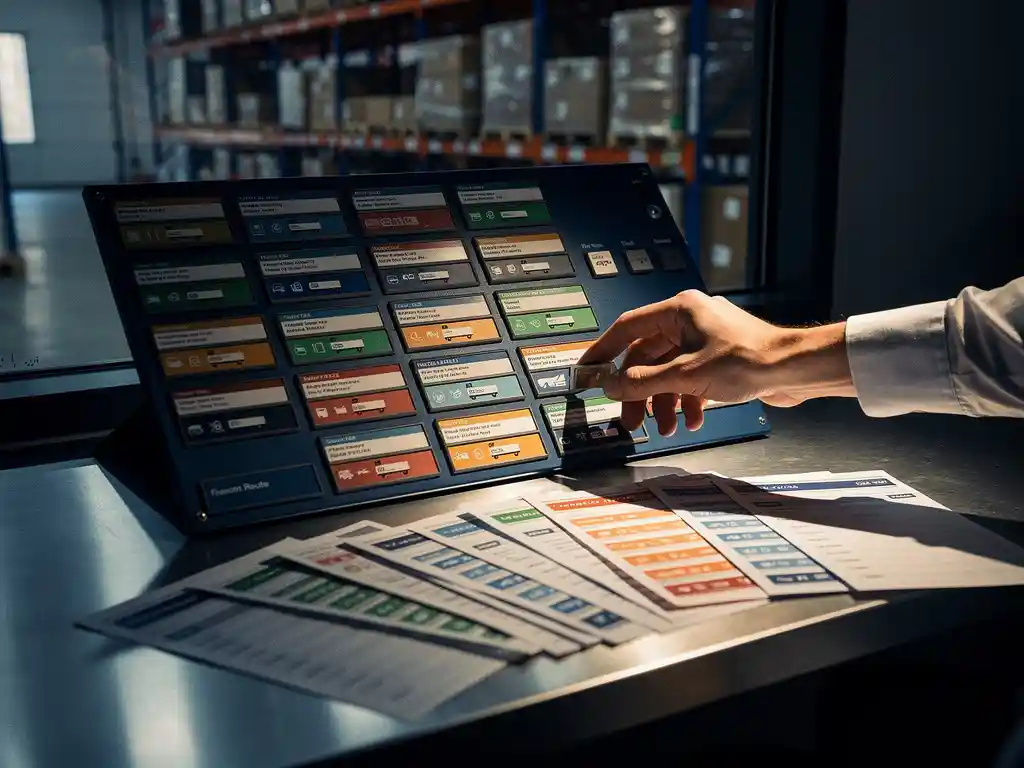
Freight scheduling is one of the most demanding tasks in logistics operations. Between managing carrier availability, order windows, route constraints, and last-minute changes, even experienced transport planners can find themselves buried in complexity before the week has properly started. That is where freight scheduling automation comes in — and understanding how it actually works can make the difference between adopting a tool that genuinely helps and one that simply adds another layer to manage.
This article walks through the core questions planners ask when exploring automation: what it is, how it works, where manual processes fall short, and what a modern, AI-driven approach looks like in practice.
What is freight scheduling automation?
Freight scheduling automation is the use of software — increasingly powered by artificial intelligence — to plan, assign, and coordinate transport orders without requiring manual input at every step. Instead of a planner building schedules from scratch each day, the system ingests live order data, applies planning logic, and automatically generates optimized schedules.
At its most basic level, automation handles the repetitive, rule-bound parts of scheduling: matching loads to carriers, checking time windows, grouping shipments by route or region, and flagging conflicts. At a more advanced level, AI-driven systems go further by reasoning through exceptions, adapting to real-time changes, and learning from the decisions planners make over time. The goal is not to remove the planner from the process, but to free them from the low-value tasks that consume the most time.
How does automated freight scheduling actually work?
Automated freight scheduling works by continuously ingesting live data — orders, carrier availability, route parameters, and constraints — and using planning logic to generate optimized load and route assignments in real time. Modern, AI-driven systems break this down into a cycle of data intake, task decomposition, solver execution, output validation, and exception escalation.
Here is what that cycle looks like in practice:
The system receives incoming orders through connected channels such as portals, email, or APIs.
An orchestration layer splits the problem into manageable tasks and calls the appropriate solvers or carrier APIs.
Outputs are validated against constraints before being confirmed as part of the plan.
Exceptions that fall outside predefined parameters are flagged for human review rather than forced through an imperfect solution.
This end-to-end orchestration is what separates modern automation from older scheduling tools. Rather than running a single optimization pass on a static dataset, the system keeps planning in motion as conditions change throughout the day. A planning assistant built on this kind of architecture can handle the full scheduling cycle without requiring a planner to intervene at every step.
What are the biggest limitations of manual freight scheduling?
The biggest limitations of manual freight scheduling are speed, scalability, and consistency. A human planner can process only so many variables at once, and as order volumes grow, the cognitive load becomes unsustainable. Errors increase, response times slow, and critical updates get missed during busy periods.
Manual scheduling also struggles with real-time responsiveness. When a carrier cancels at short notice or a new urgent order arrives, a planner must mentally re-evaluate the entire schedule — a process that can take hours on a busy Monday morning. By the time a revised plan is ready, conditions may already have shifted again. This lag between event and response is one of the most costly inefficiencies in traditional freight operations, leading to empty kilometers, missed time windows, and unnecessary costs.
What’s the difference between rule-based planning tools and AI-driven scheduling?
Rule-based planning tools follow fixed logic: if condition A is met, apply action B. AI-driven scheduling, by contrast, reasons through situations dynamically, weighing multiple variables simultaneously and adapting when conditions change. The key difference is flexibility — rule-based systems break down when reality does not match the rules, while AI systems adjust.
Rule-based tools work well in stable, predictable environments. They are fast and consistent when inputs are clean and conditions are controlled. But real logistics operations are rarely that tidy. Carrier delays, order amendments, weather disruptions, and capacity fluctuations create situations that no fixed ruleset can fully anticipate.
AI-driven freight scheduling automation bridges this gap by combining structured optimization logic with the ability to handle messy, unstructured inputs. It can interpret an email cancellation, identify which loads are affected, check carrier alternatives against contract rates and historical performance, and produce a revised plan — all within minutes rather than hours. A dedicated coordination assistant can manage exactly this kind of cross-carrier, multi-order complexity in real time.
What tasks can freight scheduling automation handle on its own?
Freight scheduling automation can independently handle order intake, load grouping, carrier matching, route optimization, constraint checking, and exception flagging. These are the high-volume, repeatable tasks that consume a disproportionate share of a planner’s day.
Specifically, automation handles well:
Grouping and consolidating shipments into optimized load plans based on route, weight, and delivery windows.
Matching orders to carriers based on availability, contract rates, and past performance.
Detecting conflicts such as capacity overloads or time window violations before they become problems.
Escalating genuine exceptions — situations that actually require human judgment — rather than burying them in routine tasks.
What automation does not replace is the planner’s judgment on complex, context-dependent decisions. A good system recognizes where its confidence is limited and surfaces those situations clearly, keeping the planner in control of the decisions that matter most.
How do transport planners start using freight scheduling automation?
Transport planners typically start using freight scheduling automation by connecting it to their existing workflow — not by replacing their current tools. The most practical entry point is a solution that works alongside the systems already in use, so planners can see the value without committing to a disruptive migration.
The learning curve matters here. Automation tools that require weeks of configuration before delivering results create friction that discourages adoption. The most effective implementations are operational quickly and learn from the planner’s actual behavior over time, adapting to individual preferences, remembered exceptions, and specific operational patterns rather than applying generic logic.
Planners do not need to hand over control to get value from automation. The right approach treats automation as a capable colleague that handles the volume work, flags what needs attention, and gets better at anticipating the planner’s decisions the more they work together.
How LogicPlan helps with groupage planning automation
Our Groupage Planning Automation service is built specifically to tackle one of the most time-consuming parts of freight scheduling: consolidating transport orders into optimized load plans. Powered by AI agents and large language models, it analyzes live order data, carrier constraints, and route parameters to cluster shipments intelligently — in real time, not as a one-time batch calculation.
Here is what that means for planners in practice:
Groupage decisions reflect actual, current conditions rather than yesterday’s data.
The system works alongside your existing TMS via a browser extension — no migration, no disruption.
It learns your planning patterns and improves its suggestions over time, becoming more aligned with how you think.
You stay in control: the AI handles the volume, and you handle the judgment calls.
LogicPlan is not here to replace transport planners. We are here to give them back the time and mental space to focus on the decisions that actually require their expertise. If you want to see how groupage planning automation works in your operation, we would be happy to show you.
Frequently Asked Questions
How long does it typically take to see results after implementing freight scheduling automation?
Most planners begin seeing measurable results within the first few weeks of use, particularly in time saved on routine load grouping and carrier matching tasks. Because modern solutions like LogicPlan work alongside your existing TMS without requiring a full migration, the ramp-up period is significantly shorter than traditional software rollouts. The system also improves over time as it learns your specific planning patterns, meaning results compound the longer you use it.
What happens when the automation makes a mistake or produces a plan I disagree with?
A well-designed automation system always keeps the planner in the loop — you retain full authority to review, adjust, or override any suggested plan before it is confirmed. When you correct the system, that feedback becomes part of how it learns and refines future suggestions. The key is choosing a tool that treats planner overrides as valuable input rather than a failure state.
Do we need to replace our existing TMS to use freight scheduling automation?
No — and you should be cautious of any solution that requires a full system replacement as a precondition. The most practical automation tools are designed to integrate with your current TMS, often through APIs or browser-based extensions, so your team can adopt them without a disruptive migration. This also means planners can evaluate the tool's real-world value before making any larger infrastructure commitments.
How does freight scheduling automation handle last-minute changes, like a carrier cancellation or an urgent new order?
This is actually one of the strongest use cases for AI-driven automation. When a disruption occurs — a carrier drops out, a new priority order arrives, or a time window shifts — the system can immediately re-evaluate affected loads, check alternative carrier options against contract rates and availability, and produce a revised plan in minutes. This replaces a process that could otherwise take a planner hours of manual re-evaluation, especially during peak periods.
Is freight scheduling automation only suitable for large logistics operations, or can smaller teams benefit too?
Automation delivers value at a range of operational scales, and smaller teams often benefit disproportionately because each planner carries a heavier individual workload. A team of two or three planners managing high order volumes has very little buffer for the slow, manual tasks that automation eliminates. The critical factor is not company size but order complexity and the volume of repetitive scheduling decisions made each day.
What data does freight scheduling automation need to get started, and how clean does it need to be?
At minimum, the system needs access to live order data, carrier availability, and basic route or constraint parameters — most of which already exist in your TMS or operational workflows. Data cleanliness is a common concern, but modern AI-driven systems are built to handle messy, unstructured inputs, including information arriving via email or non-standard formats. You do not need a perfectly structured data environment to begin; the system is designed to work with real-world operational data as it actually exists.
How do I know if our operation is ready for freight scheduling automation, or if we should improve our processes first?
A useful signal is whether your planners are regularly spending significant time on repetitive, rule-bound tasks — load grouping, carrier matching, conflict checking — rather than on judgment-intensive decisions. If the answer is yes, automation can add value now, even if your processes are not perfectly optimized. In fact, deploying automation often surfaces process inefficiencies that were previously hidden by manual workarounds, making it a practical diagnostic tool as much as a productivity one.
Next blog