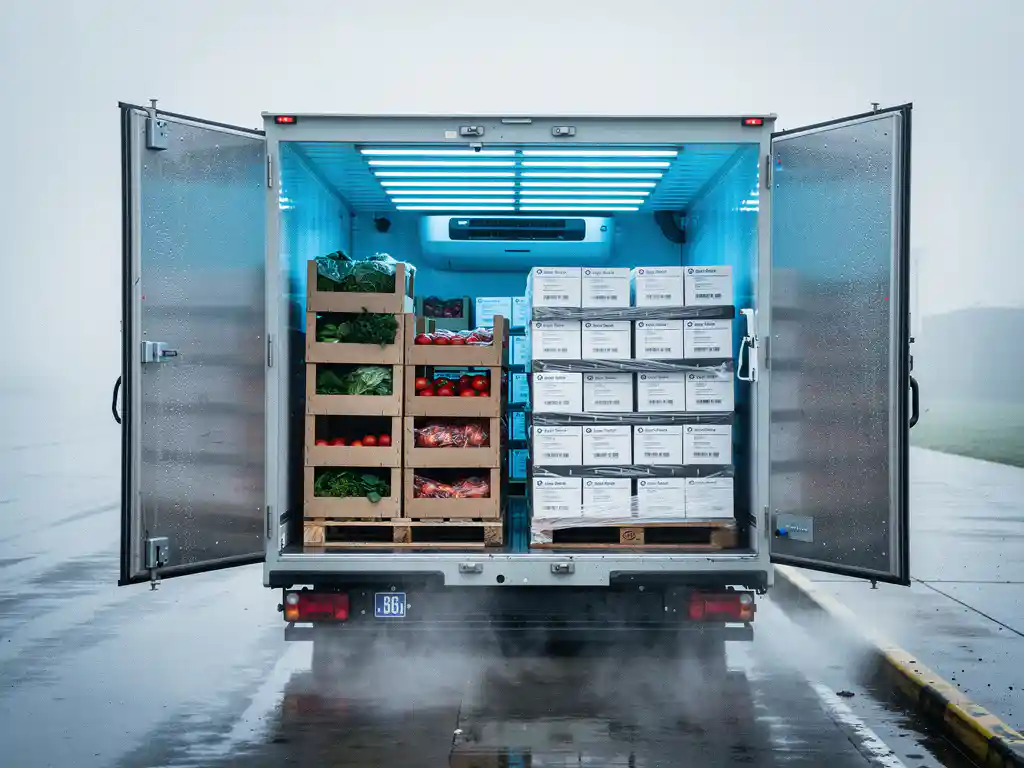
Groupage transport is one of the most cost-effective ways to move goods across Europe, but when those goods need to stay cold, the stakes get significantly higher. Temperature-sensitive shipments introduce a layer of complexity that goes far beyond standard freight consolidation, and understanding how groupage handles that complexity can make the difference between a successful delivery and a spoiled load.
Whether you are a transport planner juggling multiple cold-chain orders or a logistics manager evaluating your shipping options, this guide walks you through everything you need to know about groupage transport and temperature-controlled goods, from the basics to how modern AI tools are reshaping the planning process.
What is groupage transport and how does it work?
Groupage transport is a freight model in which multiple shipments from different senders are consolidated into a single truck or trailer, with each shipper paying only for the space their cargo occupies. Instead of booking a full vehicle, businesses share capacity with other shippers, making it a practical and economical option for smaller consignments that do not fill an entire truck.
The process typically works through a logistics provider or freight forwarder, who collects individual shipments, consolidates them at a depot or cross-docking facility, and then dispatches the combined load along a shared route. Each shipment is tracked individually and delivered to its respective destination. This model is especially common in European road freight, where dense route networks make consolidation both efficient and commercially attractive.
What counts as temperature-sensitive goods in groupage shipping?
Temperature-sensitive goods in groupage shipping are any products that require a controlled environment to maintain their quality, safety, or regulatory compliance throughout transit. This includes chilled goods such as dairy, fresh produce, and certain pharmaceuticals, as well as frozen products like meat and ready meals, and ambient-sensitive items such as chocolate, wine, or cosmetics.
The specific temperature range required varies significantly between product categories. Chilled goods typically need to stay between 2°C and 8°C, while frozen cargo demands temperatures below -18°C. Some pharmaceutical products require even tighter tolerances. In a groupage context, this creates an immediate challenge: not all products in the same truck will share the same temperature requirements, which means carriers must use multi-compartment vehicles or carefully segment the load.
How does groupage transport maintain cold chain integrity?
Groupage transport maintains cold chain integrity through a combination of temperature-controlled vehicles, careful load planning, and continuous monitoring. Carriers use refrigerated trailers with multi-zone capability, allowing different sections of the truck to maintain different temperatures simultaneously. Pre-cooling the vehicle before loading and minimising door-open time at each stop are essential operational practices.
Load planning and documentation
Effective cold-chain groupage relies heavily on precise load planning. Shipments with incompatible temperature requirements must be physically separated, and the sequence of deliveries needs to be optimised so that cargo is not exposed to ambient temperatures for longer than necessary at intermediate stops. Accurate documentation, including temperature logs and delivery records, is also required for regulatory compliance, particularly for food and pharmaceutical shipments governed by GDP (Good Distribution Practice) guidelines.
Real-time monitoring
Modern cold-chain groupage increasingly depends on real-time temperature monitoring using IoT sensors placed within the trailer. These sensors transmit continuous data to a central system, alerting planners immediately if a temperature deviation occurs. The ability to act on that alert quickly—whether by rerouting, adjusting refrigeration settings, or notifying the customer—is what separates a recoverable situation from a total loss.
What are the biggest risks of shipping perishables via groupage?
The biggest risks of shipping perishables via groupage are temperature excursions during loading and unloading, extended transit times due to multiple stops, and the potential for incompatible goods to share the same compartment. Each additional stop on a groupage route creates a moment of vulnerability during which cold-chain integrity can be compromised.
Temperature excursions at depot cross-docking points
Delays caused by other shipments on the same route
Insufficient compartmentalisation for mixed-temperature loads
Limited visibility into real-time conditions during transit
Beyond temperature, there is also the risk of damage from improper stacking or contact with incompatible products. Perishable goods are often more fragile than standard freight, and the shared nature of a groupage load means your cargo is handled alongside shipments from other businesses. Choosing a carrier with clear cold-chain protocols and documented handling procedures significantly reduces these risks.
When should you choose groupage over full truckload for cold goods?
Groupage is the right choice for temperature-sensitive goods when your shipment volume does not justify the cost of a full truckload, your delivery timeline allows for the additional transit time created by multiple stops, and your carrier has verified cold-chain capabilities for consolidated loads. For smaller consignments of chilled or frozen goods, groupage can offer substantial cost savings without compromising product integrity.
Full truckload (FTL) becomes the better option when speed is critical, when your goods have very narrow temperature tolerances that make shared transport risky, or when your volume fills a trailer anyway. Pharmaceutical cold-chain shipments, for example, often require FTL precisely because the compliance requirements and temperature sensitivity make any additional handling unacceptable. For fresh produce or dairy with a longer shelf life and a moderate volume, groupage is frequently the smarter commercial decision.
How is AI changing temperature-controlled groupage planning?
AI is transforming temperature-controlled groupage planning by enabling real-time consolidation decisions that account for temperature compatibility, route efficiency, and carrier capability simultaneously. Traditional planning tools rely on static rules that cannot adapt quickly when conditions change. AI-powered systems can re-evaluate grouping decisions on the fly, responding to cancellations, new orders, and live traffic or temperature alerts without requiring a planner to start from scratch.
For transport planners specifically, the value of AI lies in reducing the cognitive load of managing multiple temperature-sensitive orders across a shared network. Rather than manually cross-referencing temperature requirements, carrier contracts, and route timing, an intelligent coordination assistant surfaces the right consolidation options and flags potential conflicts before they become problems. This is particularly valuable on high-pressure mornings when a wave of new orders arrives simultaneously.
It is worth noting that AI in this context works best as a support layer alongside experienced planners, not as a replacement for their judgment. The nuances of cold-chain logistics, from customer relationships to product-specific handling requirements, still depend on human expertise. AI handles the data-heavy legwork so planners can focus on decisions that genuinely require their knowledge.
How LogicPlan helps with groupage transport planning
Our Groupage Planning Automation service is built specifically to address the complexity that temperature-sensitive groupage creates for transport planners. Using AI agents powered by large language models, we analyse live order data, carrier constraints, temperature requirements, and route parameters to cluster shipments into optimised groups in real time. The result is faster planning, fewer errors, and load plans that reflect current conditions rather than assumptions made hours earlier.
Automatic detection of temperature compatibility between consolidated shipments
Real-time re-planning when cancellations or new orders arrive
Works alongside your existing TMS via a browser extension, with no migration required
Crucially, LogicPlan is designed as a tool that learns alongside your planners, not one that replaces them. Our system adapts to individual planning patterns, remembers exceptions, and improves over time based on the decisions your team makes. If you want to see how intelligent groupage automation can reduce planning time and protect your cold chain, get in touch with LogicPlan and we will show you what it looks like in practice.
Frequently Asked Questions
How do I verify that a groupage carrier is genuinely equipped for cold-chain shipments before booking?
Ask the carrier for documented evidence of their cold-chain capabilities, including ATP certification for their refrigerated vehicles, GDP compliance records if they handle pharmaceuticals, and examples of their temperature monitoring setup. Request a copy of their cold-chain standard operating procedures (SOPs) and check whether they carry insurance specifically covering temperature excursion losses. A reputable carrier will share this information readily — hesitation or vague answers is a red flag worth taking seriously.
What should I do if a temperature excursion is detected during a groupage shipment?
Act immediately by contacting the carrier to understand the duration, severity, and cause of the excursion, and request the raw temperature log data for your records. Depending on the product type, you may need to involve your quality assurance team to assess whether the goods are still fit for sale or use — for pharmaceuticals, this is a mandatory step under GDP guidelines. Document everything thoroughly, as you will need this data for any insurance claim, customer notification, or regulatory reporting.
Can frozen and chilled goods ever travel in the same groupage truck?
Yes, but only in a multi-compartment vehicle where each zone is independently temperature-controlled and physically separated from the others. A properly equipped multi-temp trailer can maintain frozen conditions (below -18°C) in one zone while keeping a chilled zone at 2–8°C simultaneously. Always confirm with your carrier that the specific trailer assigned to your shipment has this capability, and get written confirmation of the temperature zones planned for your cargo before dispatch.
How much longer does groupage typically take compared to a dedicated full truckload for cold goods?
Transit times for groupage are generally 20–50% longer than a dedicated FTL on the same origin-destination lane, depending on the number of consolidation points and delivery stops on the shared route. For cross-border European groupage, this can mean the difference between a two-day and a three-to-four-day delivery window. When evaluating whether this is acceptable, factor in your product's remaining shelf life at the point of dispatch — if your chilled goods have a 14-day shelf life, a one-day difference matters far less than it would for a product with a 5-day window.
What documentation do I need to prepare for a temperature-sensitive groupage shipment?
At a minimum, you will need a commercial invoice, packing list, and CMR consignment note that explicitly states the required temperature range for your goods. For food shipments crossing EU borders, health certificates and TRACES notifications may also be required. Pharmaceutical shipments must comply with GDP documentation standards, including a written agreement with the carrier confirming their GDP compliance. Building a documentation checklist specific to your product category and the countries involved will save significant time and help you avoid delays at border crossings.
What are the most common mistakes shippers make when booking cold-chain groupage for the first time?
The most frequent mistake is assuming that any refrigerated groupage service is automatically suitable for all temperature-sensitive goods — in reality, not all carriers have multi-zone capability or robust monitoring systems. Shippers also commonly underestimate transit time when calculating shelf life margins, leaving too little buffer for unexpected delays. A third common error is failing to communicate special handling requirements clearly at the time of booking, which can result in your goods being loaded in an incompatible zone or handled without the necessary care at cross-docking points.
At what shipment volume does it start making financial sense to switch from groupage to a dedicated cold-chain FTL?
As a general rule of thumb, once your shipment regularly fills more than 60–70% of a standard trailer, the cost difference between groupage and FTL narrows enough that the speed, control, and reduced handling risk of a dedicated truck often tips the balance. The exact threshold depends on the lane, the carrier, and your product's sensitivity, so it is worth running a direct cost comparison that includes not just the freight rate but also the cost of potential losses, insurance, and the value of faster delivery. Many logistics managers find it useful to review this calculation quarterly as their volumes evolve.
Next blog