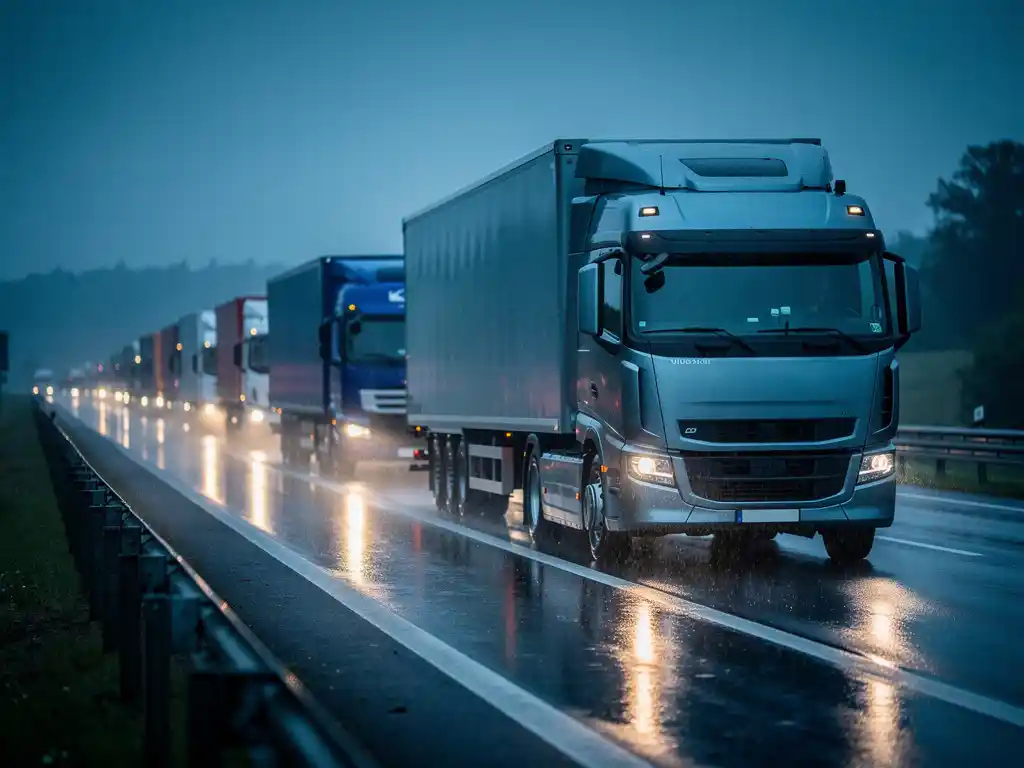
Autonomous vehicles are no longer a distant science fiction concept. From self-driving trucks being tested on European motorways to platooning trials across Scandinavia, the technology is advancing faster than many logistics professionals expected. For transport planners working in groupage operations, this raises a genuinely important question: what does it actually mean for the way we plan, consolidate, and coordinate freight?
Groupage transport is one of the most complex and coordination-heavy segments of road logistics. Understanding how autonomous vehicles will interact with that complexity requires an honest look at both the technology’s current state and the real demands of groupage planning. This article works through the key questions planners are asking right now.
What is groupage transport and how does it work today?
Groupage transport is a logistics model in which multiple shipments from different customers are consolidated into a single vehicle load, with each shipment sharing the cost and capacity of that journey. It is the standard approach for smaller freight volumes that do not justify a dedicated full truckload, and it relies on precise coordination between collection points, consolidation hubs, and delivery stops.
In practice, groupage planning today is a highly manual and judgment-intensive process. A planner must match incoming orders against available capacity, group shipments that share compatible routes and time windows, and sequence stops in a way that respects delivery commitments without creating inefficiency. Every morning brings new cancellations, late additions, and changed pickup times that force replanning on the fly. The human planner is not just running calculations — they are interpreting ambiguous information, weighing trade-offs, and making calls that no static system can fully anticipate.
What are autonomous vehicles and how close are they to reality?
Autonomous vehicles in freight transport are trucks or vans capable of navigating roads and executing journeys without continuous human control. The technology is categorized on a scale from Level 1 (basic driver assistance) to Level 5 (full autonomy in all conditions). Most commercial deployments today operate at Level 2 or 3, meaning the vehicle can handle specific scenarios but still requires a human to be available to intervene.
For long-haul transport on predictable motorway routes, Level 4 autonomy — where the vehicle manages the full journey within a defined operational domain — is already being piloted by several major manufacturers. Urban last-mile delivery, with its unpredictable environments and complex stop sequences, remains significantly further away from reliable autonomous operation. This distinction matters enormously for groupage transport, which typically involves both trunk-haul legs and urban delivery stops.
How will autonomous vehicles change groupage route planning?
Autonomous vehicles will change groupage route planning by removing some of the constraints that currently shape how routes are built, while introducing new variables that planners will need to account for. Driver-hours regulations, rest-stop requirements, and shift-handover logistics currently limit how routes can be structured. Autonomous trucks operating within approved corridors could run longer legs without these constraints, opening up new consolidation possibilities.
At the same time, route planning will not become simpler. Autonomous vehicles require highly accurate mapping data, defined operational zones, and specific infrastructure conditions. A planner building groupage routes will need to understand where autonomous operation is permitted, where a human driver takes over, and how that handover affects timing. The planning logic becomes more layered, not less. Tools that can process these parameters in real time and adapt plans when conditions change will become essential rather than optional — which is precisely where a capable planning assistant delivers measurable value.
What happens to load consolidation when trucks drive themselves?
Load consolidation in groupage transport becomes both more flexible and more demanding when trucks operate autonomously. On the flexible side, autonomous vehicles could, in theory, be dispatched more responsively — picking up a late-arriving shipment without the same scheduling friction that comes with coordinating a human driver’s availability. This opens the door to tighter consolidation windows and more dynamic grouping decisions.
The demanding side is equally real. Consolidation decisions will need to account for the autonomous vehicle’s operational profile: its approved route, its sensor limitations in certain weather conditions, its handover points, and its integration with loading dock systems that may not yet be designed for driverless arrivals. The core challenge of groupage — matching the right freight to the right vehicle at the right time — does not disappear. It evolves, and the systems supporting consolidation decisions need to evolve with it.
Will autonomous vehicles replace transport planners in groupage operations?
Autonomous vehicles will not replace transport planners in groupage operations. A vehicle executing a route autonomously is a different capability from the intelligence required to decide what goes on that vehicle, in what sequence, under what conditions, and how to respond when something changes. Those decisions require contextual judgment, knowledge of supplier relationships, and the ability to handle exceptions that no algorithm can fully anticipate.
What will change is the nature of the planner’s work. Routine execution tasks may decrease as automation handles more of the operational layer. But the need for a skilled planner to oversee complex consolidation decisions, manage exceptions, and apply experience-based judgment will remain — and arguably become more important as the operational environment grows more complex. The best planning tools are those that support and amplify the planner’s capabilities rather than attempting to replace them. A coordination assistant that learns from the planner’s decisions, remembers how exceptions were handled, and surfaces the right information at the right moment is far more valuable than one that tries to automate the planner out of the picture.
How should transport companies prepare for autonomous groupage fleets?
Transport companies preparing for autonomous groupage fleets should focus on three areas: data quality, planning system flexibility, and team capability. Autonomous vehicles depend on accurate, structured data — clean order data, precise location information, and reliable carrier and route parameters. Companies that invest in data quality now are building the foundation that autonomous operations will require.
Audit and improve the quality of order, route, and carrier data in your current systems
Evaluate whether your planning tools can adapt in real time as operational conditions change
Involve your planning team in preparing for new workflows — their knowledge is the asset that bridges current operations and future technology
Start with automation in areas where it delivers immediate value, such as consolidation and replanning, to build confidence and capability
Planning system flexibility matters because the transition to autonomous vehicles will not happen overnight or uniformly. Companies will operate mixed fleets — some autonomous, some conventional — for an extended period. Planning tools need to handle both without requiring a full system migration or a complete change in how planners work.
How LogicPlan helps with groupage transport planning
Whether autonomous vehicles arrive in two years or ten, the pressure on groupage planning is real today. Consolidation decisions are made under time pressure, with incomplete information, across multiple systems. That is exactly the problem we built LogicPlan to address.
Our Groupage Planning Automation service uses AI agents to analyze live order data, carrier constraints, and route parameters and cluster shipments into optimized groups in real time. It does not replace the planner — it works alongside them, learning from their decisions and improving over time. Key capabilities include:
Real-time consolidation that reflects actual, current conditions rather than static rules
Adaptive intelligence that remembers exceptions and learns individual planning patterns
LogicPlan deploys via a browser extension that works alongside your existing TMS tools, with no migration required and operational from the moment of installation. If you want to see how it fits into your groupage operation, we would be glad to show you.
Frequently Asked Questions
How long will it realistically take before autonomous trucks are common in groupage operations?
Most industry analysts expect a gradual, decade-long transition rather than a sudden shift. Long-haul motorway segments could see meaningful autonomous deployment within five to seven years, but the urban delivery stops that are central to groupage operations are likely to remain human-driven well beyond that. Companies should plan for a prolonged mixed-fleet period and ensure their planning systems can handle both conventional and autonomous vehicles simultaneously.
What are the biggest mistakes transport companies make when evaluating automation for groupage planning?
The most common mistake is treating automation as an all-or-nothing replacement for existing processes rather than a layer that enhances them. Companies often underestimate the importance of data quality going in — even the most sophisticated planning tool will produce poor outputs if order data, location information, and carrier parameters are inconsistent or incomplete. A second frequent error is excluding experienced planners from the evaluation process, when in fact their operational knowledge is essential for configuring, validating, and improving any automated system.
How should a transport planner think about upskilling to stay relevant as automation increases?
Planners should focus on developing skills that complement automation rather than compete with it — specifically, exception management, cross-functional communication, and the ability to interpret and challenge data-driven recommendations. Understanding how AI planning tools make decisions, and knowing when to override them, will become a core competency. Engaging with new tools early, even in a pilot capacity, is one of the most practical ways to build confidence and influence how those tools are configured for real-world operations.
Will autonomous vehicles affect groupage pricing and how costs are split between customers?
Autonomous vehicles have the potential to reduce certain cost components — particularly those tied to driver hours, rest requirements, and shift handovers on trunk-haul legs — which could eventually shift how groupage costs are modelled and allocated. However, new cost variables will emerge, including infrastructure fees for autonomous corridors, additional mapping and sensor maintenance requirements, and the overhead of managing human-to-autonomous handover points. In the near term, cost structures are unlikely to change dramatically, but companies should monitor how early adopters in their sector are handling these new variables.
Can existing Transport Management Systems handle the additional complexity that autonomous vehicles introduce?
Most legacy TMS platforms were not designed with autonomous vehicle parameters in mind — they lack native support for operational domain restrictions, handover point scheduling, or sensor-condition flags that autonomous routing requires. Rather than waiting for a full TMS overhaul, companies can bridge this gap by layering specialist planning tools on top of existing systems, provided those tools are designed for compatibility. The key capability to look for is real-time adaptability: the ability to re-optimise groupage plans dynamically as autonomous vehicle constraints and live operational conditions change.
What role does weather or road condition data play in planning groupage routes for autonomous vehicles?
Weather and road conditions are significantly more consequential for autonomous vehicles than for human-driven ones, because sensor performance — particularly for LiDAR and camera systems — can degrade in heavy rain, snow, or fog. A groupage route that is operationally sound under normal conditions may require a human takeover or a full reroute when conditions change. Planners will need access to live environmental data feeds integrated into their planning tools, and should build contingency logic into consolidation decisions for routes that pass through weather-sensitive corridors.
Is it worth investing in planning automation now, before autonomous vehicles are widely deployed?
Yes — and the case for doing so is independent of autonomous vehicle timelines. The consolidation and replanning challenges in groupage operations are significant right now, under entirely conventional fleets. Investing in smarter planning tools today improves operational efficiency immediately, while simultaneously building the data discipline and system flexibility that autonomous operations will eventually require. Companies that wait for autonomous vehicles to arrive before modernising their planning infrastructure will face a steeper and more disruptive transition than those who start incrementally now.
Next blog