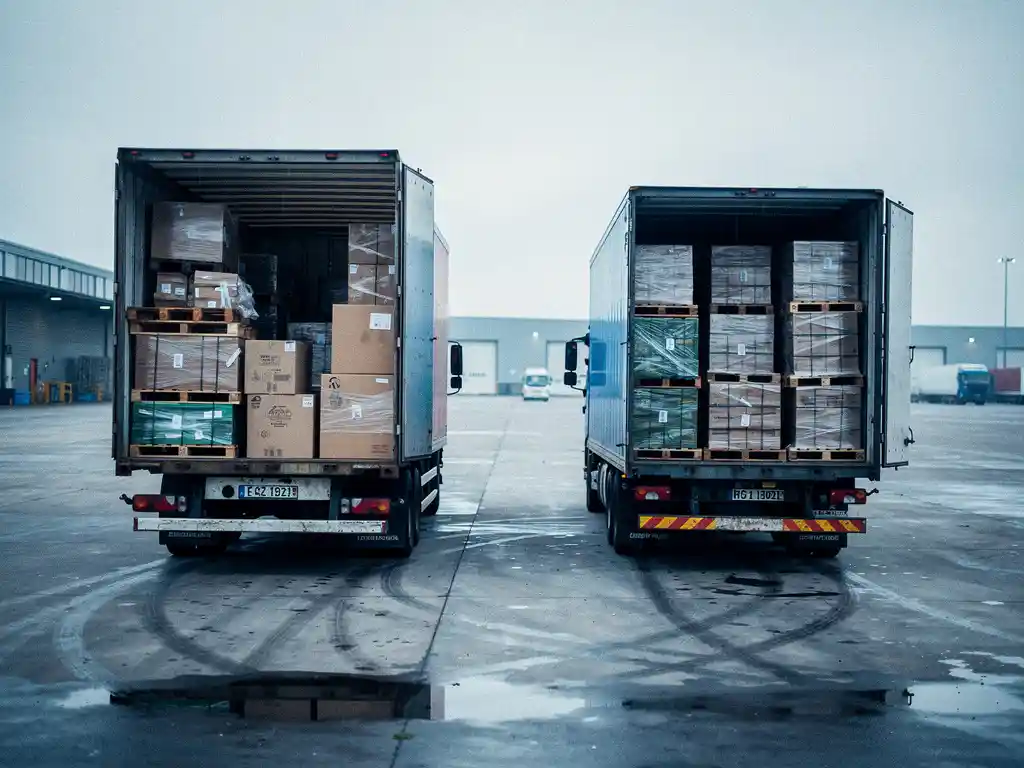
Choosing the right freight model is one of those decisions that shapes your entire day as a transport planner. Get it right, and your loads move efficiently, costs stay predictable, and customers stay happy. Get it wrong, and you’ll be chasing delays, absorbing unexpected charges, and explaining to management why the budget is off. Understanding the difference between groupage transport and dedicated freight is a foundational skill for anyone managing logistics operations.
This article walks through the key questions transport planners ask when comparing these two models, from basic definitions to smarter, AI-assisted ways of making the call in real time.
What is groupage transport and how does it work?
Groupage transport is a shipping model in which multiple smaller shipments from different shippers are consolidated into a single vehicle or container. Each shipper pays only for the space their cargo occupies, while the carrier fills the remaining capacity with freight from other customers, spreading the total transport cost across several parties.
In practice, a carrier or freight forwarder collects shipments at a consolidation hub, sorts them by destination, and loads them together onto a single truck or container. The vehicle then follows a route that serves multiple delivery points. This model is particularly well suited to shipments that do not fill an entire trailer, typically referred to as less-than-truckload (LTL) freight in North American terminology, or groupage in European logistics contexts.
The consolidation process introduces additional handling steps compared with direct freight, which means transit times are generally longer. However, for shippers with smaller volumes or non-urgent cargo, the cost savings often outweigh the time trade-off. For transport planners, groupage adds complexity because a single vehicle now carries obligations to multiple customers, each with its own delivery windows and requirements.
What is dedicated freight and when is it used?
Dedicated freight means a single shipper books an entire vehicle exclusively for its cargo. The truck travels directly from origin to destination without stopping to collect or deliver for other customers. This model is also known as full truckload (FTL) or charter freight, and it is used when speed, security, or volume justifies the higher cost.
Dedicated freight is the right choice in several situations:
The shipment fills or nearly fills the entire vehicle.
The cargo is time-critical and cannot absorb consolidation delays.
The goods are fragile, hazardous, or require special handling that makes co-loading impractical.
The shipper needs full control over the vehicle and its movements.
Because the shipper absorbs the full cost of the vehicle regardless of how much space is used, dedicated freight becomes economically wasteful for small or irregular volumes. It is most cost-effective when the load factor—meaning the percentage of vehicle capacity actually used—is high.
Is groupage transport cheaper than dedicated freight?
Yes, groupage transport is generally cheaper than dedicated freight for smaller shipments because the cost of the vehicle is shared across multiple shippers. However, groupage remains the more economical option only when your shipment volume is genuinely below the threshold at which booking a full vehicle makes financial sense.
The break-even point depends on your cargo volume, the route, and current market rates. As a rough rule of thumb, once a shipment occupies roughly 60 to 70 percent of a trailer’s capacity, the price difference between groupage and dedicated freight narrows significantly. At that point, booking a dedicated vehicle can be competitive because you gain faster transit, fewer handling touchpoints, and a reduced risk of damage or delay.
For transport planners managing mixed freight across different customers or product lines, the decision is rarely straightforward. Groupage saves money on individual shipments but introduces more coordination overhead. Dedicated freight simplifies execution but carries a higher unit cost. The cheapest option depends on the full picture, not just the base rate.
What hidden costs should you watch out for in groupage transport?
Groupage transport can carry hidden costs that erode the initial price advantage. The most common include surcharges for additional handling, delays caused by other shippers in the same consolidation, redelivery fees when recipients are unavailable, and fuel or peak-season surcharges applied per shipment rather than per vehicle.
Transit-time variability is another indirect cost that planners often underestimate. When a groupage shipment misses a delivery window, the downstream consequences can include customer penalties, rescheduling costs, and reputational damage that never appears on the freight invoice. Longer dwell times at hubs also increase the risk of damage, particularly for goods that require careful handling.
Administrative overhead adds up, too. Managing groupage means tracking multiple partial shipments, reconciling invoices from carriers that bill per consignment, and handling exceptions when one shipment in a consolidated load causes a problem for the rest. These are real costs even if they do not appear on a freight quote.
How do transport planners decide between groupage and dedicated freight?
Transport planners typically weigh four factors when choosing between groupage and dedicated freight: shipment volume relative to vehicle capacity, urgency and delivery-window requirements, cargo characteristics such as fragility or hazardous classification, and total cost, including surcharges and administrative burden.
In practice, the decision often comes down to load factor and time sensitivity. A planner managing a 10-pallet shipment with a flexible three-day delivery window will almost always route it through groupage. The same planner handling a 20-pallet urgent order for a production line will likely book a dedicated vehicle, even at a higher cost, because the risk of a groupage delay is too expensive.
Experienced planners also factor in carrier reliability by lane. Some groupage networks perform consistently on certain corridors and less reliably on others. Building that lane-level knowledge into the decision is what separates reactive planning from genuinely optimised operations. This is exactly where having a planning assistant that remembers past performance and surfaces it at the moment of decision becomes valuable.
Can AI help optimise the choice between groupage and dedicated freight?
Yes, AI can meaningfully improve the groupage-versus-dedicated-freight decision by analysing live order data, carrier performance history, route parameters, and cost structures simultaneously—something that is practically impossible to do manually at scale. Rather than relying on rules of thumb, an AI-assisted planner can make each decision based on the actual conditions at that moment.
AI adds the most value in consolidation logic. Grouping shipments efficiently requires evaluating dozens of variables at once: compatible delivery windows, geographic clustering, carrier capacity, and contractual constraints. Static, rule-based systems struggle with this because real logistics does not follow clean rules. A coordination assistant that can reason across these variables in real time produces better groupage plans with fewer empty kilometres and less manual rework.
Importantly, AI in this context works best as a support layer for planners, not a replacement. The goal is to give planners better information and faster analysis so their judgment is applied where it matters most, not to remove them from the process. A planner who understands the freight model still needs to make the call. AI just makes sure they are making it with the full picture in front of them.
How LogicPlan helps with groupage transport planning
At LogicPlan, we built our Groupage Planning Automation service specifically to address the complexity that makes groupage decisions time-consuming and error-prone. Our AI agents analyse live order data, carrier constraints, and route parameters to cluster shipments into optimised groups in real time, replacing the manual bundling process that consumes so much of a planner’s morning.
Here is what that looks like in practice:
AI agents ingest live orders and automatically identify consolidation opportunities based on destination, volume, and delivery window.
Carrier performance data is factored into every groupage decision, so the system learns which lanes and partners deliver reliably.
Exceptions that require human judgment are escalated to the planner immediately, not buried in a queue.
The solution works alongside your existing TMS via a browser extension, with no migration or disruption to your current setup.
We designed LogicPlan to work with planners, not around them. The system learns your planning patterns, remembers exceptions, and improves over time, so each week it becomes a more accurate reflection of how your operation actually works. It does not substitute your expertise; it amplifies it. If you want to see how LogicPlan can reduce your groupage planning time and improve load efficiency, get in touch with us today.
Frequently Asked Questions
How do I know if my shipment volume is too close to the break-even point to make a clear decision?
When your shipment sits in the 50–70% capacity range, it is worth running a side-by-side cost comparison that includes surcharges, expected transit time variability, and any downstream penalties for late delivery — not just the base freight rate. If the total cost difference is under 10–15%, lean toward dedicated freight for the added reliability unless your delivery window is genuinely flexible. Over time, tracking actual outcomes by lane will help you calibrate where your personal break-even threshold sits for each corridor.
What are the most common mistakes transport planners make when using groupage for the first time?
The most frequent mistake is treating groupage like a direct service and quoting customers transit times that don't account for consolidation delays or multi-stop routing. Planners also tend to underestimate the administrative load — managing multiple consignment numbers, reconciling per-shipment invoices, and handling exceptions across a shared load takes significantly more time than managing a single dedicated vehicle. Starting with a small set of well-understood lanes before scaling groupage across your entire operation helps you build realistic expectations before committing.
How should I handle cargo that is partially time-sensitive within a groupage shipment?
If only part of a shipment is time-critical, consider splitting the order: route the urgent portion as dedicated freight and consolidate the remainder through groupage. While this adds a coordination step, it is usually more cost-effective than upgrading the entire shipment to dedicated just to protect one component. Make sure your TMS or planning tool supports split-order visibility so both legs can be tracked without creating blind spots in your delivery confirmation process.
Can groupage transport work for hazardous goods or temperature-controlled cargo?
It can, but with significant constraints. Hazardous goods shipped under groupage must be compatible with the other cargo in the same load, which requires careful classification checks and carrier confirmation before booking. Temperature-controlled groupage (also called multi-temp or part-load reefer) exists in most markets but is less widely available than ambient consolidation, and co-loading restrictions can limit your carrier options. Always verify that your carrier's groupage network is certified for the specific handling requirement rather than assuming standard groupage services cover it.
How do I evaluate whether a groupage carrier's network is reliable enough for a specific lane?
Look beyond the carrier's headline on-time delivery statistics and ask for lane-specific performance data — hub-to-hub transit times, exception rates, and average delay durations on your actual origin-to-destination corridor. If you don't have historical data yet, start with a trial period of 4–6 weeks on lower-risk shipments before committing that lane to groupage for customer-facing orders. Planners who log carrier performance by lane systematically, even in a simple spreadsheet, build a decision-making advantage that compounds over time.
What should I do when a groupage shipment causes a delay that affects other customers in the same consolidated load?
Contact the carrier immediately to understand whether the delay is isolated to your consignment or affects the entire load, since the response strategy differs in each case. If the delay is load-wide, proactively notify all affected customers before they chase you — this preserves trust and gives you time to arrange alternatives such as a dedicated re-delivery for the most time-sensitive recipients. Document the incident with timestamps and carrier communications so you have a factual record for invoice disputes, penalty claims, or future carrier performance reviews.
Is it possible to gradually automate groupage planning without replacing my existing TMS?
Yes, and this is actually the recommended approach for most operations. Rather than migrating to an entirely new platform, look for AI-assisted tools that integrate with your existing TMS via API or browser-based extensions, allowing automation to be layered on top of your current workflows without disrupting live operations. Starting with a single high-volume lane or a specific groupage corridor lets you validate the consolidation logic and measure efficiency gains before rolling the solution out more broadly — reducing both implementation risk and the learning curve for your planning team.
Next blog