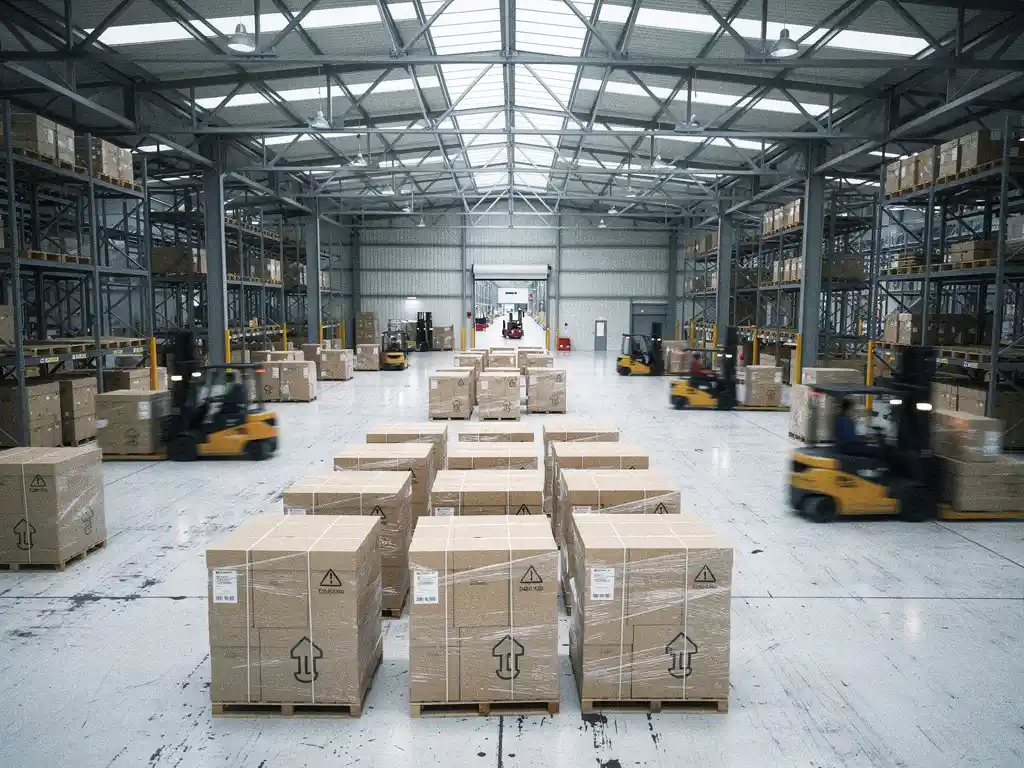
In groupage transport, efficiency depends on one thing above all else: getting the right freight together at the right time. That is where consolidation centers play a central role. Whether you are a transport planner managing dozens of daily shipments or a logistics manager looking to reduce costs, understanding how consolidation works is essential to making smarter decisions across your supply chain.
This article walks through the key questions planners and logistics professionals ask about consolidation centers—from how they operate to how modern AI is changing the way freight is grouped and planned.
How does a consolidation center actually work?
A consolidation center is a logistics facility where smaller, individual shipments from multiple senders are collected, sorted, and bundled into larger, full loads before being dispatched to their destinations. Instead of sending each shipment separately, freight is grouped by destination, delivery window, or route to maximize load efficiency.
The process typically follows a clear sequence. Inbound shipments arrive from various origins throughout the day. Staff or automated systems sort each piece by destination zone or delivery route. Once enough freight has been gathered to form an efficient load, it is consolidated onto a single vehicle and dispatched. This bundling process is what makes groupage transport economically viable for smaller shipments that would otherwise travel in half-empty trucks.
Timing is critical in this process. A consolidation center operates on fixed departure windows, which means planners must continuously balance incoming volumes against outbound schedules. Delays in one inbound shipment can affect an entire outbound load, which is why real-time visibility across the facility matters so much.
What types of freight are best suited for consolidation?
Freight that is too large for parcel services but too small to fill an entire truck is ideally suited for consolidation. This typically includes palletized goods, industrial components, retail stock replenishment, and manufactured parts that ship in regular but modest volumes.
The best candidates for groupage transport share a few common characteristics:
Shipments between 100 kg and 2,500 kg that do not require a dedicated vehicle
Goods with flexible delivery windows that allow for bundling with compatible loads
Non-hazardous, stackable freight that can safely share space with other cargo
Regular, recurring shipments on established routes where load patterns are predictable
Fragile, temperature-controlled, or time-critical freight can also move through consolidation centers, but these require additional handling protocols and more precise planning to avoid compromising other cargo in the same load.
What’s the difference between a consolidation center and a cross-docking facility?
The key difference is dwell time and purpose. A consolidation center holds freight until enough volume is gathered to form an efficient outbound load, which can take hours or even days. A cross-docking facility, by contrast, is designed for minimal storage—inbound freight is transferred directly to outbound vehicles with little to no time spent in the facility.
Cross-docking works best when inbound shipments are already pre-sorted and matched to outbound loads. It prioritizes speed and throughput over load optimization. Consolidation centers prioritize efficiency and cost reduction by waiting for the right mix of freight before dispatching.
In practice, many modern logistics hubs combine both functions. A facility might cross-dock time-sensitive freight while simultaneously consolidating slower-moving shipments on the same floor. For transport planners, understanding which mode applies to each shipment type is essential for accurate scheduling and cost allocation.
What are the main benefits of using a consolidation center?
Consolidation centers reduce transport costs by maximizing vehicle utilization and cutting the number of individual shipments that travel underloaded. They also reduce carbon emissions, simplify supplier coordination, and give receivers a single, predictable delivery window instead of multiple separate arrivals.
From a planning perspective, consolidation brings structure to what would otherwise be a fragmented flow of small shipments. Rather than coordinating dozens of individual pickups and drop-offs, planners work with consolidated loads that follow defined routes and schedules. This makes capacity planning more predictable and significantly reduces the administrative burden.
For businesses receiving goods, consolidation also means fewer dock appointments, less handling, and a lower risk of damage from multiple touchpoints across separate deliveries.
How does AI improve planning at a consolidation center?
AI improves planning at a consolidation center by analyzing live order data, carrier availability, and route parameters in real time to automatically group shipments into optimized loads. Rather than relying on fixed rules or manual bundling decisions, AI adapts to changing conditions as they happen.
Traditional planning tools apply static grouping logic—if a shipment meets certain criteria, it goes into a predefined load. This works until conditions change: a late arrival, a canceled pickup, or a sudden volume spike. At that point, a planner has to manually re-evaluate and rebuild the load plan, which takes time and introduces the risk of errors.
AI-driven planning tools handle this differently. They continuously monitor incoming orders and operational constraints, re-evaluating grouping decisions as new information arrives. When a cancellation comes in, the system identifies affected loads, checks available alternatives, and generates a revised plan without requiring the planner to start from scratch. A planning assistant built on this kind of adaptive logic can significantly reduce the time planners spend rebuilding load plans under pressure.
Importantly, this does not replace the planner’s judgment. The best AI tools work alongside planners, surfacing recommendations and flagging exceptions while leaving final decisions in human hands. The planner stays in control; the AI handles the repetitive, data-intensive work that would otherwise consume hours of their day.
How LogicPlan helps with groupage transport planning
LogicPlan’s Groupage Planning Automation is built specifically for the kind of dynamic, real-time decision-making that consolidation planning demands. Our AI agents analyze live order data, carrier constraints, and route parameters to continuously cluster shipments into efficient groups, replacing static, rule-based bundling with adaptive intelligence that reflects actual operational conditions.
Here is what that means in practice for transport planners:
Automated grouping decisions that update in real time as orders, cancellations, and constraints change
Seamless integration with your existing TMS via a browser extension, with no migration or system replacement required
A coordination assistant that supports carrier and route alignment across consolidated loads, improving with every decision you make together
Exceptions clearly escalated to you, so your judgment is applied where it matters most
LogicPlan is not here to replace transport planners. We are here to support them. Our platform learns alongside you, adapts to the way you think, and takes the repetitive load off your plate so you can focus on the decisions that genuinely require your expertise. If you want to see how AI-assisted groupage planning works in a real logistics environment, get in touch with LogicPlan today.
Frequently Asked Questions
How long does it typically take to see cost savings after switching to consolidation-based transport?
Most logistics operations begin to see measurable cost reductions within the first one to three months, once load patterns stabilize and grouping efficiency improves. The timeline depends on shipment volumes, route consistency, and how well the consolidation process is integrated with your existing planning tools. Operations with high shipment frequency and predictable routes tend to see the fastest gains, while more irregular flows may take a full quarter to optimize.
What happens when a consolidation center receives more volume than expected and loads are already planned?
Volume spikes are one of the most common challenges in groupage planning and typically require either splitting existing loads, delaying lower-priority shipments to the next departure window, or sourcing additional vehicle capacity at short notice. With manual planning, this is a time-consuming process that often leads to suboptimal decisions under pressure. AI-assisted planning tools handle this by automatically re-evaluating load configurations in real time, identifying the least disruptive solution based on current constraints and priorities.
How do I know if my current shipment volumes justify using a consolidation center?
A useful starting point is to look at your average vehicle fill rate across outbound shipments — if trucks are regularly departing at less than 70–75% capacity, consolidation is likely to deliver meaningful savings. You should also consider whether you are managing a high number of small, fragmented shipments to overlapping destination zones, which is a strong indicator that groupage transport could reduce both cost and complexity. A logistics consultant or a tool like LogicPlan can help model the potential impact based on your actual order data.
Can consolidation centers handle shipments with different delivery deadlines in the same load?
Yes, but it requires careful planning to ensure that the tightest deadline in a consolidated load does not force premature dispatch and leave the load underutilized. Planners typically set departure windows based on the earliest committed delivery time within a group, which means shipments with more flexible windows effectively subsidize faster-moving freight. AI planning tools can factor in individual delivery commitments when forming groups, helping to balance urgency with load efficiency rather than defaulting to the most conservative deadline across the board.
What are the most common mistakes transport planners make when setting up a consolidation planning process?
One of the most frequent mistakes is applying overly rigid grouping rules that do not account for real-world variability — for example, always waiting for a minimum weight threshold before dispatching, even when doing so causes downstream delivery failures. Another common issue is underestimating the importance of inbound visibility: if you cannot track when shipments will actually arrive at the consolidation center, building reliable outbound schedules becomes guesswork. Starting with a clear definition of your departure windows, acceptable fill rate ranges, and escalation triggers will give your planning process a much stronger foundation.
How does AI-assisted groupage planning integrate with an existing Transport Management System (TMS)?
Modern AI planning tools are increasingly designed to work alongside your existing TMS rather than replace it, typically through browser-based extensions or API integrations that read and write order data without requiring a full system migration. LogicPlan, for example, connects via a browser extension, meaning planners can access AI-driven grouping recommendations directly within their current workflow. This approach significantly reduces implementation risk and allows teams to start benefiting from automation without a lengthy IT project.
Is AI-assisted planning suitable for smaller logistics operations, or is it only relevant at scale?
AI-assisted planning delivers value at a range of operational scales, though the nature of the benefit shifts depending on volume. Larger operations gain most from the speed and consistency of automated re-planning when conditions change. Smaller operations, where planners are often managing multiple roles simultaneously, benefit from the reduction in manual, repetitive decision-making — freeing up time for higher-value tasks. The key question is not how large your operation is, but how much complexity and variability you are managing on a daily basis.
Next blog