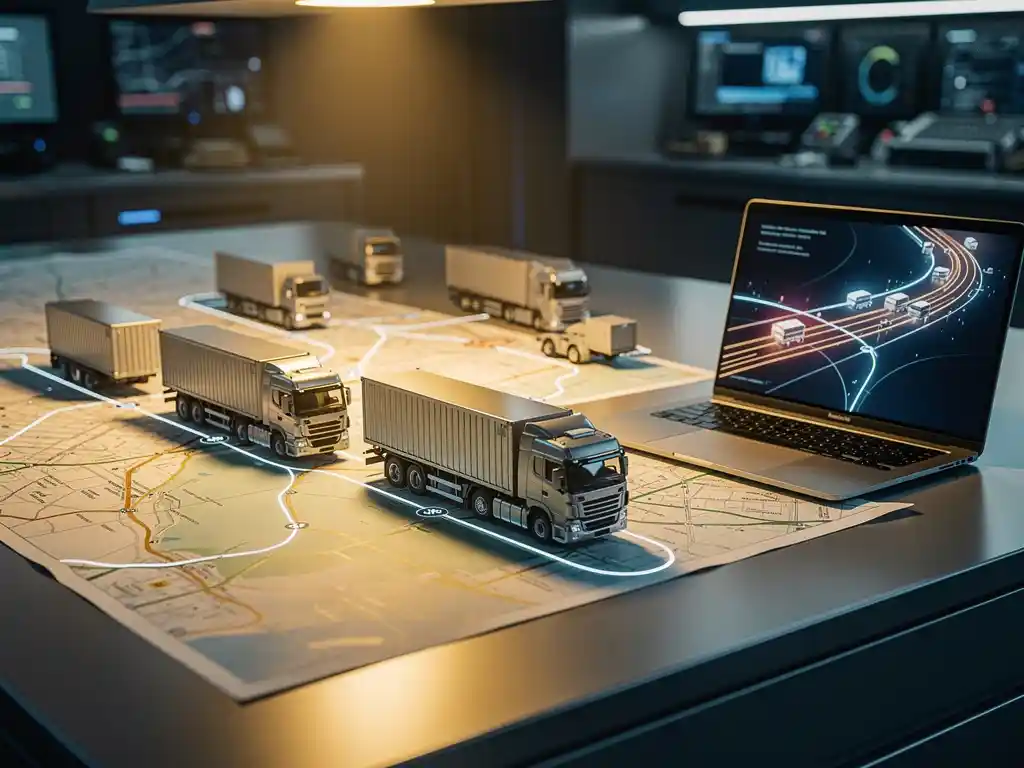
Freight planning has always been one of those jobs where the details matter enormously. A wrong carrier assignment, a missed time window, or an overlooked cancellation can ripple through an entire day’s operation. For transport planners juggling dozens of shipments across multiple systems, the pressure is constant. That’s exactly where AI freight planning is changing the game — not by replacing the planner, but by giving them a smarter, faster way to stay on top of it all.
How does AI freight planning actually work?
At its core, AI freight planning uses intelligent software agents powered by large language models to take on the cognitive heavy lifting of transport coordination. These agents don’t just follow fixed rules. They reason through problems, pull in live data from multiple sources, and adapt their outputs as conditions change in real time.
In practice, this means the system can ingest incoming orders, check carrier availability against contract rates and historical performance, group shipments into efficient load plans, and flag exceptions that genuinely need a human decision. The planner stays in control of the judgment calls. The AI handles the volume, the repetition, and the real-time monitoring that would otherwise eat up hours of the working day.
What’s the difference between AI freight planning and traditional transport software?
Traditional transport management systems are built around rules. They’re powerful within defined parameters, but they struggle the moment reality stops cooperating. A last-minute cancellation, a delayed driver, a new order that doesn’t fit neatly into the existing plan — these situations force planners back into manual mode, often working across multiple screens to piece together a solution.
An AI freight planning tool works differently. Instead of producing a static plan and leaving the planner to manage deviations by hand, it continuously monitors the operation and updates its recommendations as the situation evolves. The difference isn’t just speed. It’s the ability to handle ambiguity — to read an unstructured email, identify which shipments are affected, and generate a revised plan before the planner has even finished their coffee.
What types of transport tasks can AI freight planning handle?
Modern AI freight planning systems are designed to support a wide range of planning and coordination tasks. The most common include:
Grouping and consolidating shipments into optimized load plans based on live order data and route parameters
Monitoring active shipments and surfacing disruptions before they escalate into larger problems
Reassigning loads when cancellations or delays occur, with carrier selection informed by contract terms and past performance
Automating repetitive administrative steps like order intake, status updates, and exception logging
The key point is that freight planning automation doesn’t mean removing the planner from the loop. It means making sure the planner’s attention goes where it actually matters, rather than being absorbed by tasks the system can handle independently.
Why are transport planners adopting AI freight planning now?
The timing isn’t accidental. In 2026, the combination of rising operational complexity, tighter margins, and genuinely capable AI technology has created real urgency in the transport sector. Planners are dealing with more orders, more carriers, and more communication channels than ever before. The tools that worked five years ago are starting to show their limits.
There’s also a growing recognition that the problem isn’t a lack of data. Most logistics operations are already generating enormous amounts of information. The challenge is making sense of it fast enough to act on it. AI shipment scheduling addresses this directly by processing live inputs continuously and surfacing the right information at the right moment, rather than leaving the planner to hunt for it across disconnected systems.
How do you get started with AI freight planning?
One of the most common concerns among planners is that adopting new technology means disrupting what already works. That concern is understandable, and it’s one of the reasons the deployment model matters as much as the technology itself. The most effective AI freight planning tools are designed to work alongside existing systems rather than replace them — integrating through a browser extension, for example, so there’s no migration, no lengthy IT project, and no steep learning curve.
A good AI planning assistant should be operational within minutes of installation and should adapt to the way a specific planner already works. It learns individual planning patterns, remembers how exceptions were handled in the past, and improves its recommendations over time. Getting started isn’t a transformation project. It’s more like adding a very capable colleague who picks things up quickly.
How LogicPlan helps with groupage planning
Groupage planning is one of the most time-intensive parts of freight coordination. Bundling shipments efficiently requires balancing route logic, carrier constraints, time windows, and constantly changing order volumes — often under real deadline pressure. LogicPlan’s Groupage Planning Automation is built specifically to take this burden off the planner’s plate without removing their oversight.
Here’s what LogicPlan’s groupage solution does in practice:
Analyzes live order data and carrier constraints to cluster shipments into optimized groups in real time
Replaces static, rule-based grouping logic with adaptive AI orchestration that reflects actual operating conditions
Reduces planning time significantly, cutting the manual back-and-forth that typically dominates Monday mornings
Works alongside your existing TMS via browser extension — no migration, no disruption, operational within minutes
LogicPlan is not a replacement for the transport planner. It’s a tool that learns alongside you, adapts to your planning logic, and handles the volume so you can focus on the decisions that genuinely require your expertise. The real-time coordination assistant keeps you informed when something needs your attention — without burying you in noise the rest of the time. If you’re ready to see what this looks like in your operation, get in touch with LogicPlan and we’ll walk you through it.
Frequently Asked Questions
Will AI freight planning work with the TMS we already have in place?
In most cases, yes — and compatibility is one of the key design priorities of modern AI freight planning tools. Solutions like LogicPlan are built to layer on top of your existing TMS via a browser extension, meaning there's no data migration, no API integration project, and no need to replace systems your team already knows. The AI reads and works within your current environment rather than asking you to rebuild around it.
How long does it take before the AI starts delivering real value?
Unlike large enterprise software rollouts, well-designed AI freight planning tools are built for fast time-to-value. Many planners are up and running within minutes of installation, with the system immediately able to assist on live tasks. The quality of recommendations improves over time as the AI learns your specific planning patterns, carrier preferences, and how you've handled exceptions in the past — so the longer you use it, the sharper it gets.
What happens when the AI makes a recommendation I disagree with?
You override it — and that's entirely by design. AI freight planning tools are built to support planner judgment, not override it. When you make a different call, a well-built system logs that decision and factors it into future recommendations, effectively learning your reasoning over time. The planner always has the final say; the AI is there to reduce the cognitive load, not remove human accountability from the process.
Is AI freight planning only suitable for large logistics operations, or can smaller teams benefit too?
Smaller and mid-sized operations often see some of the strongest returns, precisely because their planners are stretched across more tasks with less backup. When a team of two or three is managing the same volume of exceptions, carrier communications, and load plans that a larger team might share, AI assistance has an outsized impact. The key is choosing a tool that doesn't require a dedicated IT team or lengthy onboarding to get running.
How does the AI handle disruptions like last-minute cancellations or delayed drivers?
This is one of the areas where AI freight planning shows its clearest advantage over traditional TMS logic. Rather than flagging a disruption and leaving the planner to manually work through the consequences, the AI actively monitors live conditions, identifies which shipments are affected, and generates revised assignment options based on carrier availability, contract terms, and route efficiency — all before the situation has a chance to cascade. The planner receives a clear picture of the problem and a set of actionable options, not just an alert.
What are the most common mistakes companies make when adopting AI freight planning tools?
The most frequent mistake is treating the rollout like a traditional software implementation — over-engineering the setup, delaying go-live until everything is 'perfect,' and underestimating how quickly planners adapt when the tool is genuinely useful. A close second is expecting the AI to perform optimally from day one without any calibration period. The best results come from starting with a focused use case like groupage planning or exception monitoring, letting the system learn, and expanding from there rather than trying to automate everything at once.
How does AI freight planning affect the day-to-day experience for the planner themselves?
For most planners, the most immediate change is a significant reduction in the reactive, screen-switching work that dominates busy mornings — manually cross-referencing orders, chasing carrier confirmations, and rebuilding plans after disruptions. With the AI handling continuous monitoring and surfacing only the exceptions that genuinely need a decision, planners report spending more time on the higher-value coordination and relationship work that actually requires their expertise. It shifts the job from reactive firefighting toward more deliberate, strategic planning.
Next blog