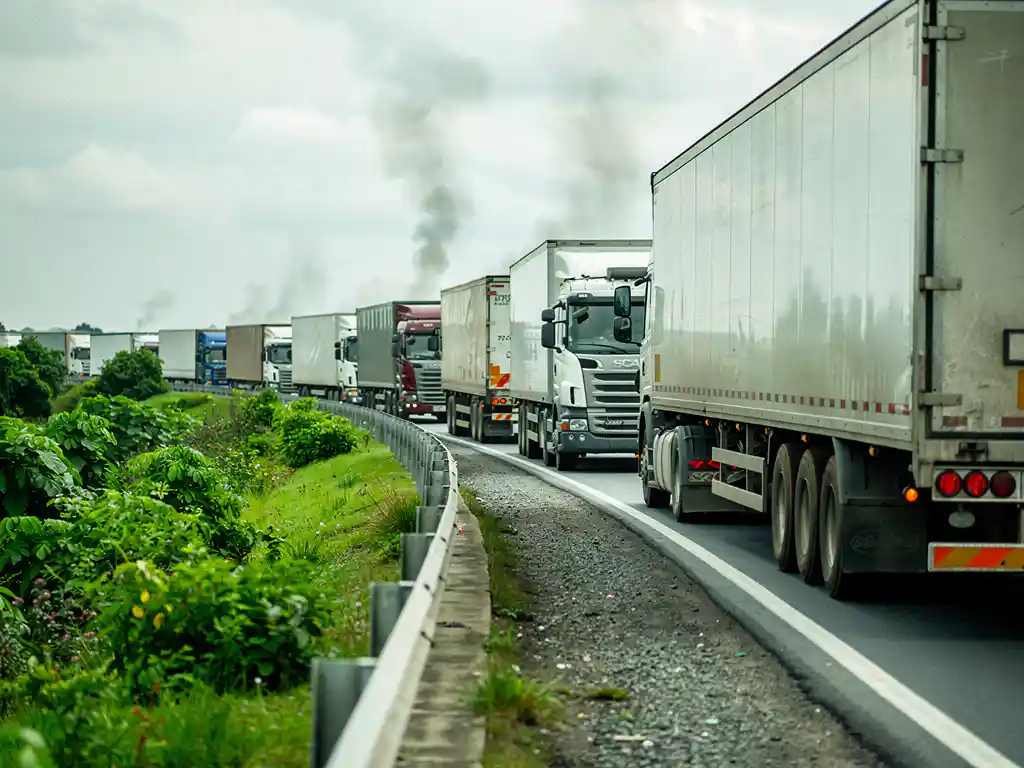
Groupage transport—the practice of consolidating multiple smaller shipments from different customers into a single truck—is one of the most common freight models in European logistics. It keeps costs down and trucks fuller, but it also raises an important question that more and more shippers, planners, and sustainability managers are asking: What is the actual carbon footprint of groupage transport, and how can it be reduced?
As environmental reporting requirements grow and supply chain sustainability becomes a board-level priority, understanding how groupage emissions are calculated, where they come from, and how smarter planning can reduce them is no longer optional. This article answers the most common questions transport planners have about groupage transport and its environmental impact.
How is CO2 calculated for groupage shipments?
CO2 emissions for groupage shipments are calculated by allocating a proportion of the truck’s total emissions to each individual shipment, based on its share of the load. The most widely used method divides total fuel consumption across the route by the total weight or volume of all shipments carried, then multiplies each shipment’s share by the emission factor for diesel or the fuel type used.
In practice, this means the calculation involves several variables: the total distance driven, the fuel consumption per kilometer (which varies with load weight, vehicle age, and road type), the fuel’s emission factor, and the shipment’s weight or volume relative to the full load. Industry frameworks such as the GLEC Framework and EN 16258 provide standardized methodologies for this kind of allocation, and many transport management systems now include built-in CO2 reporting based on these standards.
One complexity specific to groupage is that the route itself is rarely a straight line. Trucks make multiple stops for pickups and deliveries, which adds distance and idling time. These detours need to be factored into any accurate emissions calculation, which is why route efficiency plays such a significant role in the overall carbon footprint of a groupage operation.
How does groupage transport compare to full truckload in emissions?
Groupage transport generally produces lower emissions per shipment than full truckload (FTL) when the truck is well loaded. Because the vehicle’s emissions are shared across multiple shipments, each individual shipment accounts for only a fraction of the total carbon output. A well-consolidated groupage load can be significantly more carbon-efficient per tonne-kilometer than sending a half-empty dedicated truck.
However, the comparison is not always straightforward. A full truckload moving directly from origin to destination is highly efficient in terms of route distance. Groupage trucks, by contrast, make multiple stops and may travel longer total distances to serve all customers on the route. If consolidation is poor and the truck carries only a few shipments, the emissions per shipment can actually exceed those of a well-utilized FTL vehicle.
The key variable is load factor—how full the truck actually is. When groupage operations achieve high load factors through smart consolidation, they outperform FTL on a per-shipment emissions basis. When loads are poorly grouped and trucks run with excess empty space, the environmental advantage disappears quickly.
What factors make groupage transport more or less carbon-intensive?
The carbon intensity of groupage transport depends primarily on load factor, route efficiency, vehicle type, and the number of stops per route. These four factors interact constantly, and changing any one of them can meaningfully shift the emissions profile of a groupage operation.
Load factor: The higher the percentage of truck capacity used, the lower the emissions per shipment. Poorly consolidated loads waste both fuel and carbon budget.
Route design: Inefficient stop sequences, unnecessary detours, and poor geographic clustering all add kilometers and therefore emissions.
Vehicle technology: Older diesel trucks produce significantly more CO2 per kilometer than newer Euro 6 vehicles or electric alternatives.
Empty kilometers: Return trips with no cargo, or repositioning drives between pickup locations, add emissions with no freight value attached.
Beyond these primary factors, operational habits also matter. Excessive idling, suboptimal driving speeds, and last-minute order changes that force route replanning all contribute to higher-than-necessary emissions. For transport planners, this means that day-to-day decisions—not just fleet investment choices—have a direct and measurable impact on the carbon footprint of every groupage run. A planning assistant built for groupage operations can help planners act on these variables consistently, rather than relying on manual judgment under time pressure.
How can transport planners reduce the carbon footprint of groupage operations?
Transport planners can reduce the carbon footprint of groupage operations by improving load consolidation, optimizing stop sequences, minimizing empty kilometers, and making faster, better-informed replanning decisions when disruptions occur. Each of these actions directly reduces fuel consumption and, by extension, CO2 emissions per shipment.
In practice, this means grouping shipments by geographic proximity rather than just delivery windows, identifying opportunities to combine orders that would otherwise travel on separate vehicles, and designing routes that minimize total distance while respecting time constraints. It also means reacting quickly when cancellations or delays occur—because a late replanning decision often results in a truck running a suboptimal route that burns more fuel than necessary.
Planners who manage groupage well also pay close attention to carrier selection and coordination across the operation. Choosing carriers with newer, more fuel-efficient fleets, or those already operating electric vehicles on certain corridors, can make a meaningful difference to the reported emissions of a shipment, even before any route optimization takes place.
What role does AI-assisted planning play in lowering groupage emissions?
AI-assisted planning reduces groupage emissions by automating the complex, time-sensitive decisions that determine load factor and route efficiency. Where a human planner working across multiple systems may take hours to consolidate orders and design routes, an AI planning assistant can analyze live order data, carrier constraints, and route parameters in real time to cluster shipments into optimized groups—consistently and at scale.
The environmental benefit of this speed and accuracy is direct. Better consolidation means fewer trucks are needed for the same volume of freight. Smarter route sequencing means fewer total kilometers driven. And faster replanning when disruptions occur means less time spent running suboptimal routes after a cancellation or delay throws the original plan off course.
It is worth being clear about what AI planning tools do and do not do. They are not replacements for experienced transport planners. The best tools are built to work alongside planners, supporting their judgment rather than overriding it. A good AI assistant learns from the planner’s decisions over time, adapts to the specific patterns and exceptions of a particular operation, and flags situations that need human review—rather than making autonomous decisions the planner would disagree with.
How LogicPlan helps reduce emissions in groupage transport
Our Groupage Planning Automation service is designed specifically to tackle the consolidation and routing challenges that drive unnecessary emissions in groupage operations. Rather than replacing the transport planner, it works as an intelligent co-pilot—analyzing live order data, carrier availability, and route conditions to surface the best grouping decisions in real time. It learns alongside the planner, remembers exceptions, and gets smarter with every planning cycle.
Smarter consolidation: AI agents cluster shipments by geography, time window, and carrier fit—maximizing load factors and reducing the number of vehicles needed.
Fewer empty kilometers: Optimized stop sequences and real-time replanning cut unnecessary distance from every route.
Non-disruptive deployment: Our solution works alongside your existing TMS via a browser extension, so there is no migration, no downtime, and no steep learning curve.
Fast time to value: Planners are operational within minutes of installation, with the system adapting to individual planning patterns from day one.
Reducing the carbon footprint of groupage transport is not a one-time project—it is a continuous planning discipline. LogicPlan makes that discipline easier, faster, and more consistent, without asking planners to give up control. If you want to see how AI-assisted groupage planning can lower your emissions while improving operational efficiency, get in touch with LogicPlan today.
Frequently Asked Questions
What emissions reporting standards should we use for groupage transport, and are they legally required?
The most widely recognised standards for freight emissions reporting are the GLEC Framework (Global Logistics Emissions Council) and EN 16258, the European standard for calculating and declaring energy consumption and greenhouse gas emissions in transport services. While neither is universally mandated today, the EU's Corporate Sustainability Reporting Directive (CSRD) and the incoming FuelEU Maritime and road transport regulations are pushing companies toward standardised, auditable emissions data. Adopting GLEC or EN 16258 now puts you ahead of compliance requirements and makes your emissions data credible to customers and auditors alike.
How do we accurately account for groupage emissions when a single shipment passes through multiple carriers or subcontractors?
Multi-leg groupage shipments involving subcontractors are one of the trickiest emissions accounting challenges in road freight. The best practice is to collect actual distance and fuel consumption data for each leg separately and apply the appropriate emission factor per carrier and vehicle type—rather than using a single average across the whole journey. If subcontractor data is unavailable, the GLEC Framework provides default emission factors by vehicle category and region that can be used as a fallback, though actual data is always preferred for accuracy and auditability.
What is a realistic load factor target for a carbon-efficient groupage operation?
Industry benchmarks generally consider a load factor above 80% to be efficient for groupage operations, though top-performing networks regularly achieve 85–90% on well-established corridors. Below 70%, the per-shipment emissions advantage of groupage over a dedicated vehicle starts to erode significantly. Rather than chasing a single fixed target, the more useful approach is to track load factor consistently over time and identify which routes, days, or customer segments are consistently underperforming—those are the highest-leverage areas for consolidation improvement.
Can switching to electric or alternative-fuel vehicles eliminate the need to optimise groupage routes and consolidation?
No—vehicle electrification and route optimisation address different parts of the emissions problem and both remain necessary. Electric trucks reduce or eliminate tailpipe CO2 emissions, but they do not reduce the number of vehicles on the road, the total kilometres driven, or the operational costs associated with poor consolidation. In fact, range limitations and charging infrastructure constraints make smart route design and load consolidation even more critical for electric fleets than for diesel ones. Optimisation and fleet transition are complementary strategies, not alternatives.
How do we get started with measuring our groupage emissions if we have no formal process in place today?
The practical starting point is to gather three core data inputs: total distance driven per route, fuel consumption per vehicle (or a reliable default if actuals are unavailable), and the weight or volume of each shipment relative to the total load. From these, you can calculate a basic emissions allocation per shipment using the EN 16258 methodology. Many transport management systems already capture distance and load data—the gap is usually in structuring that data into a consistent reporting output. Starting with a single high-volume corridor and building a repeatable calculation process there is far more effective than trying to instrument the entire network at once.
What are the most common mistakes transport planners make that unknowingly increase groupage emissions?
The most frequent culprits are late-stage order grouping, over-reliance on fixed route templates, and slow replanning after disruptions. When consolidation decisions are made too close to departure, planners have fewer shipments to work with and less flexibility to build efficient loads—resulting in trucks leaving with avoidable empty space. Fixed route templates that were designed months ago often fail to reflect current order patterns, locking in inefficiency. And when a cancellation or delay occurs, every hour spent running the original suboptimal plan adds unnecessary kilometres and emissions. Building faster, more dynamic planning habits—supported by the right tools—addresses all three.
How should we communicate our groupage emissions reductions to customers or sustainability stakeholders?
Credibility is everything when reporting emissions improvements externally. Use standardised methodologies (GLEC or EN 16258) so your numbers are comparable and auditable, report at the shipment level rather than just as fleet-wide averages, and be transparent about whether figures represent actual measured data or modelled estimates. If you are using AI-assisted planning tools to drive consolidation improvements, quantify the impact in concrete terms—fewer vehicles deployed, total kilometres saved, tonnes of CO2 avoided—rather than describing it in qualitative terms. Customers and ESG stakeholders increasingly have the sophistication to distinguish between robust data and greenwashing.
Next blog